
ReList journal
Cut WISMO Tickets 30%: Dropshipping Support Fixes for 2026

The merchant owns customer communication, policies, and refunds, while suppliers own inventory accuracy and fulfillment. The fastest improvement you can make today is publishing a visible order-tracking page, setting channel-specific response-time targets, and automating your confirmation and first-reply messages. That single change clears up confused expectations and cuts down on the flood of “where is my order” tickets before they start.
TL;DR:
- Publishing clear shipping estimates, creating a dedicated order-tracking page, and automating initial responses can significantly reduce support inquiries.
- Support responsibilities should be divided clearly, with the merchant managing policies and refunds, and suppliers handling fulfillment and inventory updates.
- An effective tracking page must show carrier details, delivery estimates, and clear next steps, while redundancy across policies and communication channels prevents confusion.
- Integrating live order data into helpdesks, employing AI for ticket triage, and implementing recovery protocols improve efficiency and customer trust.
- Setting channel-specific response targets, such as under 30 minutes for confirmation and four hours for first replies, helps plan staffing and manage customer expectations.
Table of Contents
- Practical checklist: must-have customer service practices for dropshipping stores
- Who does what: dividing responsibilities between your store and suppliers
- Policies and an order-tracking page that actually reduce support volume
- Tools and automation: helpdesks, self-service portals, and the right role for AI
- SLA, staffing and benchmarks you can use to plan coverage
- Common ticket workflows and the fields agents need to resolve them quickly
- Proactive comms and post-purchase flows that reduce tickets and lift repeat purchases
- What running dropshipping support actually teaches you
- How ReList centralizes order status and cuts supplier back-and-forth
- Sources
- FAQ
Practical checklist: must-have customer service practices for dropshipping stores
Most support tickets in dropshipping come from missing information, not defective products. Fixing that starts with what you publish and automate before a customer ever needs to ask.
- Publish shipping windows, delivery estimates, and return terms clearly on product pages and at checkout.
- Build a dedicated order-tracking page showing carrier status and an estimated delivery window.
- Automate order confirmation and first-reply messages, and set visible response-time targets per channel.
- Write canned templates for the recurring cases: WISMO, refunds, cancellations, and damaged items.
- Send proactive delay notices whenever a peak season or a supplier issue pushes shipping past the estimate.
None of this requires new headcount. It requires deciding, in writing, what customers see and when, then automating the parts that repeat.
Who does what: dividing responsibilities between your store and suppliers
Dropshipping fails customers when nobody is clearly in charge of the answer. Set the division early so support reps are not passing blame between your store and a supplier the customer has never heard of.
- Merchant owns: customer-facing policies, refund decisions, first contact, escalation, and all outbound messaging.
- Supplier owns: inventory accuracy, fulfillment timing, carrier tracking updates, and return address and terms.
- Contract checklist: a tracking-update SLA, a turnaround time for missing-item investigations, and a named escalation contact.
- Escalation step: if a supplier misses its SLA twice in a month, move that SKU to a backup source or flag it for review.
Suppliers who miscommunicate are a common source of order errors and delays in dropshipping operations, which is exactly why the contract terms above need to be explicit rather than assumed.
Policies and an order-tracking page that actually reduce support volume
Customers open tickets when they cannot find an answer on their own. A page that answers the question before it is asked prevents the ticket entirely.
- On product and shipping pages, list realistic delivery estimates, customs notes for cross-border orders, and a link to your shipping FAQ.
- On your order-tracking page, show the carrier name, a status timeline, an estimated delivery date, and a clear next action if something looks wrong.
- In your return policy, spell out who pays return shipping, what proof is required for damage claims, and the exact time window for requests.
- Repeat the same information across the product page, checkout, footer, and confirmation email, since redundancy is what actually prevents confusion.
Order tracking is a top priority for many online shoppers, yet most sites still miss key elements of an effective tracking page, which is the gap worth closing first.
Tools and automation: helpdesks, self-service portals, and the right role for AI
The right stack connects supplier tracking data to the customer touchpoint, rather than leaving a rep to look it up manually for every ticket.
- Choose a helpdesk that pulls live order and tracking data directly into the ticket view.
- Deploy a self-service portal and a dynamic FAQ so customers can resolve WISMO and return questions without waiting on a reply.
- Use AI to triage tickets and surface knowledge-base answers, but keep a fast, visible path to a human for anything AI cannot resolve confidently.
- Before launch, check your tracking API, order sync, and webhook reliability, since AI and self-service tools are only as good as the data feeding them.
Many consumers already believe AI will improve service quality and speed, but that only holds when AI is paired with clear escalation rules that catch what it gets wrong.
Pro Tip: Route every AI-handled ticket through a confidence check: below a set threshold, hand it to a human automatically rather than letting the customer loop back through the bot.
SLA, staffing and benchmarks you can use to plan coverage
Different channels need different speeds. Chat needs a near-instant reply, social comments are reasonably answered within hours, and email can run on a business-hours clock.
| Channel or milestone | Target |
|---|---|
| Order confirmation | Under 30 minutes (source) |
| First human reply | Around 4 hours (source) |
| Shipping status update | At least every 24 hours in transit (source) |
| Median first response, — | a few hours (source) |
To plan staffing, multiply your forecasted order volume by your historical contact rate to estimate incoming tickets, then compare that number to how many tickets each agent resolves per day. During peaks, report both the median and the 90th-percentile response time, broken out by ticket type, since an average alone hides the worst delays.
Common ticket workflows and the fields agents need to resolve them quickly
A rep who has to hunt for order details on every ticket is slower and more likely to make mistakes. Give them a fixed workflow and a short list of required fields instead.
- WISMO: verify the tracking number, confirm the current ETA, escalate to the supplier if it has stalled, and offer an interim solution such as a partial refund or expedited reship.
- Refund or return: confirm eligibility against policy, send a return label or issue store credit, log the RMA, and follow up once it is resolved.
- Cancellation: check it against the supplier’s order cutoff time before promising it, since a cutoff missed by minutes can turn into a refund instead.
- Every template should carry the order ID, tracking number, photos if relevant, and the customer’s requested resolution, so nothing gets asked twice.
Proactive comms and post-purchase flows that reduce tickets and lift repeat purchases
Most support volume is preventable if the customer already knows what is happening. Run these messages on a fixed schedule rather than waiting for a question.
- Send an immediate order confirmation, followed by a shipping notice once the supplier marks it fulfilled.
- Push a status update at least once every 24 hours while the order is in transit, and a confirmation once it is delivered.
- Follow delivery with a review or cross-sell message around 48 hours later.
- Trigger an automatic exception message for delays or missing tracking, and route anything unresolved to a human within a set window.
This timing sequence is drawn from benchmark data on post-purchase messaging, and a dedicated tracking page built on the same cadence can cut inbound WISMO tickets by about 30%.
What running dropshipping support actually teaches you

The recurring failure point is never the customer. It is a supplier who updates tracking late, a return address that changes without notice, or an order cutoff nobody wrote down. Every one of those turns into a support ticket that looks like a service failure but is really a coordination gap.
What fixes it is timing, not more agents: a delay notice sent before the customer asks, paired with support that already knows the order’s status, recovers trust faster than a discount ever does. A platform that centralizes order and fulfillment status in one place removes a layer of manual supplier chasing that otherwise falls on whoever answers the ticket.
— Nikodemas
How ReList centralizes order status and cuts supplier back-and-forth
The platform gives resellers a catalog of approved supplier products, unique listing photos for each item, and a pay-after-sale model, so you are never holding stock or fronting inventory costs. Order and fulfillment status live in one workspace instead of being scattered across supplier emails and spreadsheets.
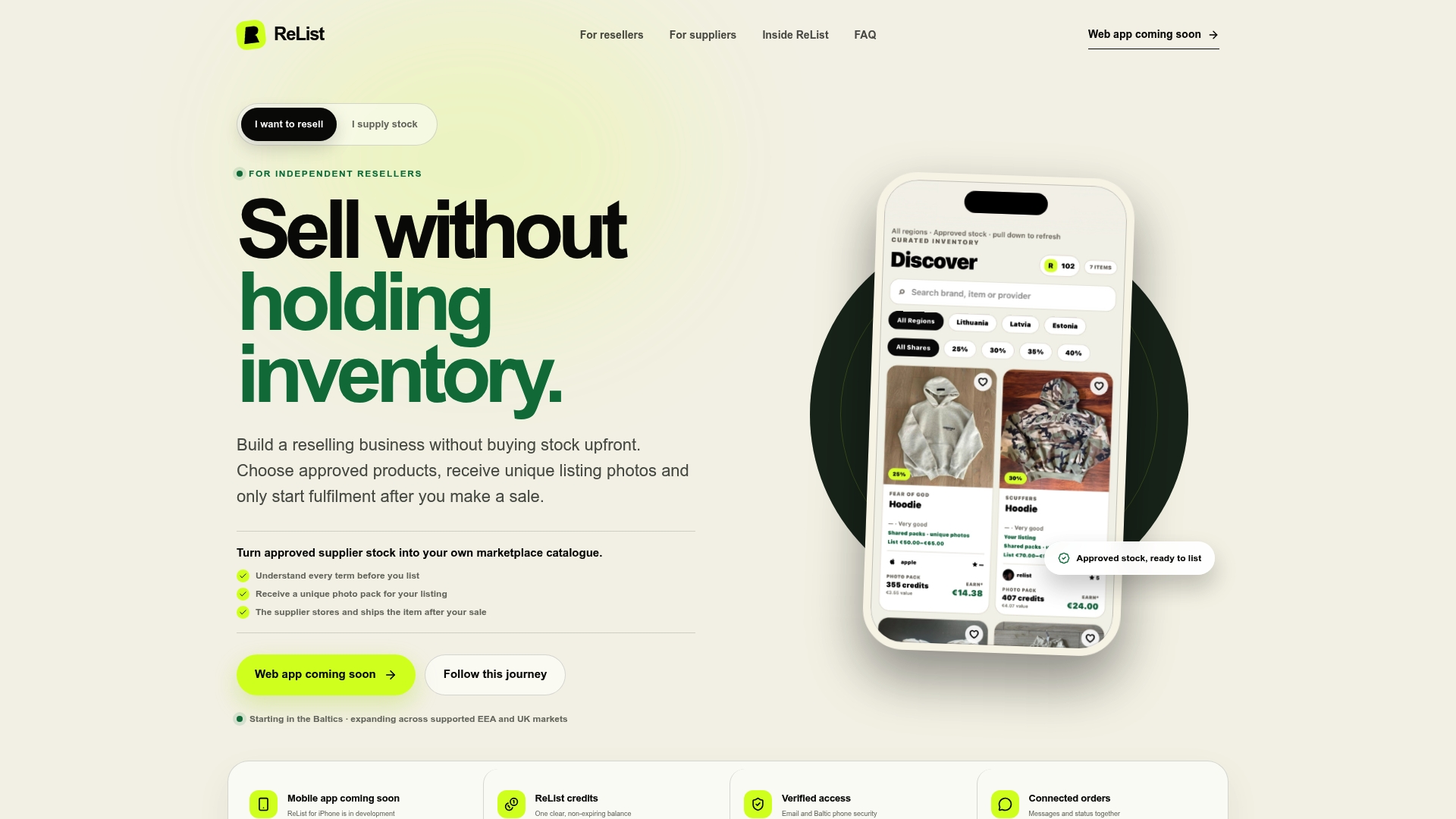
That centralization directly addresses the friction points covered above:
- No more chasing individual suppliers for a tracking update, since status is visible in one place.
- No more piecing together fulfillment data from multiple sources before you can answer a customer.
- No manual status updates, since the real-time tracker reflects what the supplier has already logged.
If you are building a resale business and want fulfillment and order status handled in one workspace instead of ten browser tabs, visit the ReList product page to see how the order-status features work, or reach out to get your account set up.
Sources
The response-time targets, tracking-page guidance, and staffing benchmarks referenced above come from a mix of CX research and e-commerce platform data.
- 2026 State of Customer Experience: Global insights for CX in the agentic era (Genesys)
- Integrate tracking info (Baymard)
- WISMO: Where Is My Order? (Salesforce Commerce)
FAQ
How do I talk to customer support as a dropshipper?
Reach out through your helpdesk or your supplier’s designated contact channel, and always include the order ID, tracking number, and a clear description of the issue. Having those details ready is what lets a rep resolve the ticket on first contact instead of asking follow-up questions.
How do dropshippers get customers?
Dropshippers typically build an audience through paid ads, social content, search-optimized product listings, and repeat purchases driven by good post-purchase communication. Retention matters as much as acquisition, since proactive shipping updates and clear policies tend to correlate with fewer tickets and better satisfaction scores.
Is dropshipping dead in 2026?
Dropshipping is not dead, but the bar for customer experience has risen, with faster response expectations and heavier reliance on self-service and AI-assisted support. Stores that publish clear tracking and policy information are better positioned than those relying on generic supplier terms.
Who is the best dropshipping agent?
There is no single best agent since fit depends on the product category, shipping region, and communication reliability of the supplier. Look for agents who commit to clear tracking-update SLAs and defined turnaround times for investigating missing or delayed items, and vet that commitment before listing their products.
How fast should I respond to a customer complaint?
Aim for a first human reply within about four hours, since that target aligns with benchmark research on post-purchase timing. Chat should be closer to real-time, while email can reasonably run on a slightly longer business-hours clock.