
ReList journal
Resellers: Find Winning Products Without Inventory, Test for $50–$200
Find winning products by running one repeatable system: detect early cultural and search signals, validate them against real commerce data, score the survivors with a weighted matrix, then test small before you scale. The three signals that matter most are cultural momentum (is this showing up in feeds before ads?), search momentum (is demand rising on Google, not just TikTok?), and commerce confirmation (are actual sellers moving units?). Your next move: spend 30 minutes tonight scanning Exploding Topics and Google Trends for three category ideas, then move to validation tomorrow.
TL;DR:
- Most products fail before testing because they lack sufficient margin, are bulky or fragile, or do not demonstrate a clear “aha” moment onscreen.
- Early trend signals are found through cultural, search, commerce, and competitive layers, with cross-platform validation crucial to avoid late-stage competition.
- Demand validation requires checking order velocity, search volume with intent, and multi-platform presence, while margin and supplier risk thresholds prevent poor selections.
- Testing costs should stay between $50 and $200 per product, with a 48- to 72-hour evaluation period focused on CPA and engagement metrics before scaling.
- Using platforms like ReList to list supplier products after scoring helps validate demand without inventory risk, enabling rapid decision-making and lower capital commitment.
Table of Contents
- What Makes a Product Actually Worth Testing
- How Do You Spot a Trend Before It Peaks?
- How Do You Validate Demand Before You Order Stock?
- What Supplier Red Flags Should Stop You From Ordering?
- Build a Weighted Scoring Matrix for Your Candidates
- How Much Should You Spend to Test a New Product?
- Turn Product Discovery Into a Weekly Habit
- Where ReList Fits Into Your Testing Cycle
- What If a Product Fails Its Test?
- Do You Need to Worry About Trademarks and Regulations?
- Why Systems Beat Instinct in Product Research
- Test More Products Without Tying Up Your Capital
- Sources
- FAQ
What Makes a Product Actually Worth Testing
Most product ideas fail before you even spend a dollar on ads, because they were never winnable to begin with. Before you touch a scoring spreadsheet or open an ad account, run every candidate through a quick attribute check.
Margin comes first. A product needs to support a landed cost low enough to leave you 3 to 5 times markup after fees, shipping, and ad spend. If your supplier price is $12 and you can’t realistically sell it above $36 to $60, keep looking. Thin margins don’t just limit profit, they remove your room to test creative and audiences, which is where most winners are actually found.
Weight and packaging matter almost as much as price. Anything bulky, fragile, or battery restricted (lithium batteries trigger extra shipping documentation and carrier restrictions) adds friction that eats into both your margin and your sanity. The best candidates fit in a small poly mailer or a padded envelope, survive a rough handling process, and don’t require special customs declarations.
Then there’s demonstrability. Can you show this product solving a visible problem in nine seconds of video? Products that have an obvious “aha” moment on camera, a gadget unfolding, a stain disappearing, a mess getting solved, consistently outperform products that require explanation. If you can’t picture the hook shot, the product will struggle in a cold-audience feed no matter how good the unit economics look.
A few more filters worth running on every candidate:
- Uniqueness versus local availability: if it’s sitting on shelves at every big box store nearby, the “where did you find this” curiosity that drives dropshipping sales disappears.
- Platform spread: products that only show up on one platform (say, only AliExpress) often lack the cross-validation that separates a real trend from a supplier’s overstock push.
- Perceived value versus price anchoring: an item that looks like it costs more than it does creates the pricing headroom that funds your ad spend; an item that looks exactly like its price tag gives you no margin to work with.
- Repeat or gift potential: products people buy more than once, or buy for someone else, tend to have longer sales curves than one-and-done novelty items.
How Do You Spot a Trend Before It Peaks?
You spot a trend early by watching it move through four distinct layers, cultural, search, commerce, and competitive, before it shows up in everyone else’s ad account. Most sellers only check the last layer, which is exactly why they enter after the profit has already been extracted by whoever got there first.
This layered discovery model works because each layer confirms a different kind of demand. Cultural signals tell you people are talking about something. Search signals tell you people are actively looking to buy it. Commerce signals tell you people are already buying it somewhere. Competitive signals tell you whether the opportunity is still open or already crowded.
Here’s how to work through the layers in order:
- Scan cultural signals first. Open TikTok Creative Center and check the trending hashtags and top-performing ads by category. Pull up Pinterest’s trend feed for aesthetic and seasonal cues. You’re looking for content volume that’s climbing week over week, not a single viral clip.
- Cross-check with Google Trends. Type the product name into Google Trends and set the range to 12 months. An “early” curve slopes up gradually with room to keep climbing. A “peaked” curve spikes hard, then flattens or drops, meaning the wave already broke and you missed the paddle-out window.
- Run it through an AI-powered trend aggregator. Tools like Exploding Topics scan signals across search, social, and retail data simultaneously, which catches momentum that a single-platform check misses. Filter by “regular” versus “exploding” growth status, and prioritize anything still in the regular to exploding transition.
- Check commerce confirmation. Look at Amazon’s Movers & Shakers list in the relevant category, or check order counts on supplier marketplaces. Rising sales rank velocity here means real buyers, not just curious scrollers.
- Finish with a competitive check. Search the product in Meta Ad Library or an ad-spy tool. A handful of ads running for a few weeks signals room to enter. Dozens of ads running for months signals a saturated category where your CPA will be brutal from day one.
Set your filters deliberately at each step. On Google Trends, ignore anything with a single sharp spike and no sustained baseline. On TikTok Creative Center, filter by your product category and sort by “most viewed” over the last 7 to 30 days, not all time, since all time buries new movement under old viral hits.
Pro Tip: Save your Exploding Topics searches and Google Trends comparisons instead of rebuilding them from scratch each week. A saved query takes ten seconds to recheck and turns trend hunting into a five-minute daily habit instead of an hour-long research session.
How Do You Validate Demand Before You Order Stock?
You validate demand by checking four numbers before you commit a dollar: order velocity, search volume with buying intent, cross-platform presence, and your actual landed margin. Skipping any one of these is how sellers end up with a warehouse of a product nobody wanted.
Start with order velocity. If you’re sourcing through a marketplace that shows order history, look at whether recent order counts are climbing month over month or flat. A supplier listing with 4,000 total orders spread across two years is a dead signal. The same 4,000 orders accumulated in the last six weeks is a live one.
Next, check search volume and, more importantly, search intent. A keyword tool showing rising volume for “[product name] review” or “[product name] buy” signals people ready to purchase. Rising volume for “[product name] how it works” often signals curiosity without purchase intent yet, which means you’re early but the wave hasn’t fully formed.
Multi-platform presence is your strongest confirmation. A product showing up on Amazon’s bestseller charts, moving inventory on TikTok Shop, and trending on AliExpress simultaneously has demand that isn’t dependent on one algorithm’s mood that week. A product only visible on a single platform is riskier, even if the numbers there look good.
Sellers who validate margin through landed-cost simulation before testing avoid the false positives that come from strong-looking demand paired with weak unit economics.
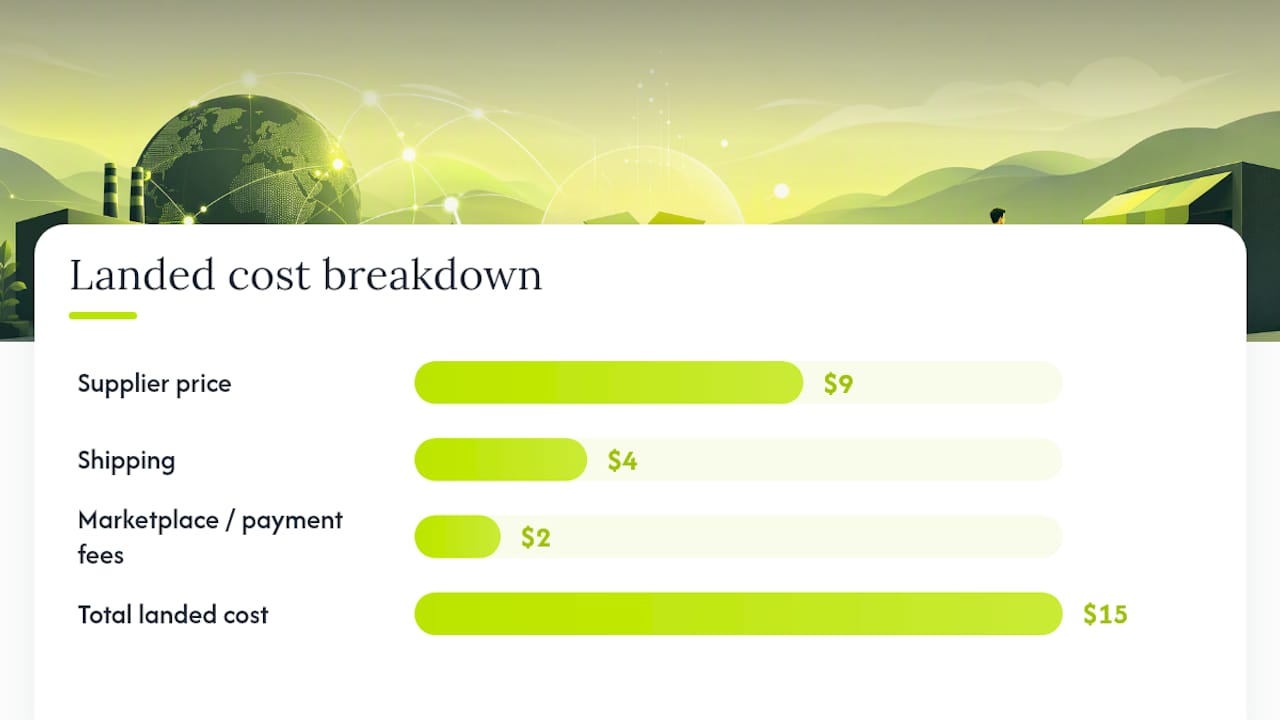
Here’s a worked example. Say your supplier price is $9, shipping runs $4, and marketplace or payment fees take another $2. Your landed cost is $15. At $45 to $60, you’re in the range that leaves room for ad spend and still nets a profit.
Watch for these false positive traps:
- Single-spike demand: a product that suddenly trended because of one viral video, with no sustained search or commerce activity behind it, usually cools within two to three weeks.
- Micro-virality: strong engagement within a tiny niche audience that never reaches broader search or marketplace confirmation.
- Seasonal false reads: a spike tied to one holiday or event that won’t repeat until next year, unless you’re specifically building a seasonal catalog.
- Supplier-inflated numbers: some listings pad order counts through bundled or historical data that doesn’t reflect current velocity.
What Supplier Red Flags Should Stop You From Ordering?
A supplier’s rating, dispute rate, and review pattern should stop you before price ever enters the conversation. The best product idea in the world fails if the person fulfilling it ships broken units or takes six weeks to deliver.
Check the supplier’s overall rating and store age first. A store under six months old with no track record carries more risk regardless of how good their photos look. A dispute rate above a few percentage points, most marketplaces display this on the seller’s storefront, means enough buyers had a bad enough experience to escalate it formally, which is a louder signal than a low star rating alone.
Read the 1 and 2 star reviews specifically, not the average. You’re looking for a repeated pattern: multiple buyers mentioning the item arrived broken, the wrong size showed up, or the product looked nothing like the listing photos. One angry review is noise. Five reviews describing the same defect is a signal the supplier has a real quality control problem.
Before committing to a full test, run through this checklist:
- Order a sample yourself. There’s no substitute for holding the product and timing the actual delivery window.
- Check stated lead time against the supplier’s shipping history. A listed 7 to 10 day window that reviewers report as 3 weeks is a red flag for your future customer service load.
- Confirm minimum order quantities if you’re moving beyond a pay-per-sale model, since a high MOQ can force capital commitment you didn’t plan for.
- Weigh the actual shipped package, not just the product weight, since packaging materials often push items into a higher shipping tier than expected.
- Check fragility. Anything glass, anything with small moving parts, or anything that could shift and crack in transit needs padding that adds cost and weight.
Pro Tip: Order your sample to a residential address, not your business address, if the platform lets you choose. Some suppliers treat business-flagged orders differently, and you want to see exactly what a real customer receives.
Build a Weighted Scoring Matrix for Your Candidates
Score every candidate on five criteria, weight them by what matters most to your strategy, and only move forward with anything that clears a 7 out of 10 total. This turns “I have a good feeling about this” into a number you can actually compare across ten different product ideas.
A weighted scoring model prevents the most common mistake in product research: falling in love with one strong signal (usually trend momentum) while ignoring a weak one (usually margin or supplier risk) that later sinks the whole test.
Here’s a starting framework, adjusted for a paid-ad-first strategy:
- Trend momentum, weighted 20%. Score based on where the product sits on your Google Trends and Exploding Topics curves. Still climbing scores 8 to 10. Flattening scores 3 to 5.
- Demand strength, weighted 20%. Score based on order velocity and multi-platform confirmation from your validation step.
- Margin, weighted 25%. Score based on your landed-cost calculation. A 4 to 5x markup scores 9 to 10. A 2 to 3x markup scores 3 to 4, and should usually be rejected outright regardless of other scores.
- Low saturation, weighted 20%. Score based on your ad-library check. Few ads running under 30 days scores high. Dozens of long-running ads score low.
- Supplier risk, weighted 15%. Score based on rating, dispute rate, and review patterns. Any confirmed quality complaint pattern caps this score at 4 regardless of other factors.
To compute the total, multiply each 0 to 10 score by its weight, then sum. A product scoring 9 on trend, 8 on demand, 7 on margin, 6 on saturation, and 8 on supplier risk works out to (9×0.20) + (8×0.20) + (7×0.25) + (6×0.20) + (8×0.15) = 1.8 + 1.6 + 1.75 + 1.2 + 1.2 = 7.55 out of 10. That clears a typical 7.0 pass threshold and earns a test budget.
If you’re building for organic and content-driven growth rather than paid ads, shift weight away from trend momentum and toward niche defensibility and how well the product supports a branding story, since organic strategies reward products with staying power over pure novelty.
For anything scoring 6.0 to 6.9, treat it as a borderline candidate: worth a smaller initial test budget, but not worth committing your full testing allocation until one weak criterion improves.
How Much Should You Spend to Test a New Product?
Spend between $50 and $200 per product across three to five ad creatives, and give the test 48 to 72 hours before making a keep or kill decision. This range is small enough to test multiple candidates in parallel without burning your budget on one unproven idea, and large enough to generate a meaningful signal rather than noise.
Before spending a dollar, confirm your landing page and offer are actually ready:
- Check your product page loads in under three seconds on mobile, since slow pages kill conversion before your ad creative even gets credit for the click.
- Confirm your price and shipping cost are clearly stated up front, not revealed at checkout, which is one of the fastest ways to spike cart abandonment.
- Make sure you have at least three to five distinct creative angles, not five versions of the same video, so you’re actually testing different hooks rather than the same idea five times.
- Set your audience targeting broad enough to gather data fast, then narrow later once you see who’s converting.
- Watch cost per acquisition against your price, targeting a CPA at or below roughly 30% of your sell price as a rough early guardrail, adjusted for your actual margin math from the scoring step.
Track click-through rate and add-to-cart rate alongside CPA. A high CTR paired with a weak add-to-cart rate usually means your ad promise and your landing page don’t match. A strong add-to-cart rate paired with weak purchases often points to a checkout or pricing friction problem, not a product problem.
Pro Tip: Resist the urge to judge a test before the 48 hour mark, even when the first few hours look rough. Ad platforms need time to optimize delivery, and killing a campaign at hour six often kills a product that just needed the algorithm to find its audience.
If a product clears your CPA target and shows a healthy add-to-cart rate by hour 72, scale spend gradually, roughly 20% to 50% increases every couple of days, rather than doubling budget overnight, which usually resets the algorithm’s learning phase and tanks performance temporarily. If metrics are weak across the board, check your creative angle and audience before killing the product entirely. Sometimes it’s not the product, it’s the hook.
Turn Product Discovery Into a Weekly Habit
The sellers who consistently find winners aren’t smarter, they’re more consistent. Product discovery works like a funnel that needs constant new input, not a one-time research sprint you do when you’re out of ideas.
Here’s a cadence that keeps the pipeline full without eating your whole week:
- Monday: scan Exploding Topics and TikTok Creative Center for new candidates, flag anything interesting in a tracking sheet.
- Tuesday and Wednesday: run validation checks (search volume, order velocity, multi-platform presence) on anything flagged Monday.
- Thursday: score validated candidates through your weighted matrix and pick your top one or two for testing.
- Friday: launch or check on active ad tests, review 48 to 72 hour data on anything running.
- Monthly: review your full candidate tracking sheet, since a product you passed on eight weeks ago sitting in “regular” growth status might now be climbing into “exploding” territory.
Automate what you can. Set Google Trends alerts for category keywords you track often. Save your Exploding Topics searches so you’re rechecking the same query weekly instead of rebuilding it. Build a watchlist in TikTok Creative Center for categories you’re monitoring.
Keep a simple tracking sheet with four fields for every candidate: date flagged, current growth phase (regular, transitioning, exploding, peaked), weighted score, and test result if you ran one. This turns your research into a searchable history instead of scattered notes across browser tabs, and it’s the single habit that separates sellers who find one winner by accident from sellers who find winning products on a repeatable schedule.
Where ReList Fits Into Your Testing Cycle
Once you’ve scored a candidate and decided it’s worth a real test, the next bottleneck is usually capital and time, ordering inventory, waiting on shipping, and hoping the product moves before cash gets tied up. This is the exact gap Joinrelist was built to close.
A platform exists that lets you list supplier products with unique photos to test real customer demand without buying stock first. Payments happen after a sale, and the supplier handles storage and shipping thereafter. For a workflow built around testing multiple SKUs on a $50 to $200 budget per candidate, that structure matters: your test budget goes entirely toward ad spend and learning, not toward inventory that might sit unsold if the product underperforms.
The moment to bring ReList into your process is right after a candidate clears your scoring threshold. Instead of placing a wholesale order to secure inventory before you know if the ad angle will work, you can list the product, run your creative test, and only commit capital to fulfillment once a real customer has already paid. If the product fails your 48 to 72 hour test, you’ve lost ad spend, not warehouse space.
This also solves a problem the scoring matrix can’t: supplier risk after the fact. Because ReList works with approved suppliers and coordinates fulfillment directly, a reseller isn’t left managing broken communication with an overseas factory mid-test. The real-time status tracker means you know where an order stands without chasing updates manually, which matters most in the exact week you’re deciding whether to scale or kill.
What If a Product Fails Its Test?
A failed test isn’t a dead end, it’s data that tells you whether to kill the product entirely or pivot the angle around it. Most products that fail their first ad test aren’t bad products, they’re bad presentations of a product that might still work.
Before killing a product outright, separate the failure type. If CTR was strong but conversions were weak, the product interest exists, but your landing page, price, or offer needs work before you retest. If CTR itself was weak across all creatives, the hook isn’t landing, and a different angle or a different platform might change the outcome entirely. If both were weak and CPA blew past your target immediately, that’s usually a genuine kill signal.
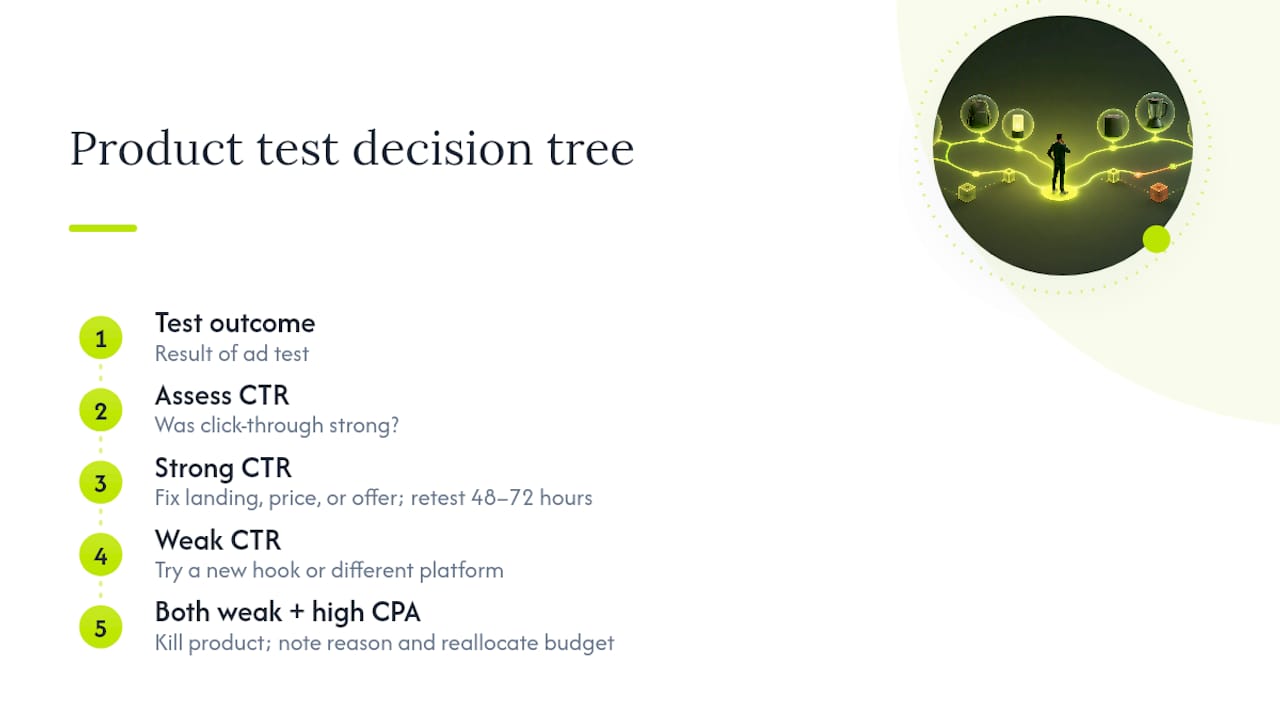
For a genuine kill, don’t linger. Pull the ad, note the result and reasoning in your tracking sheet, and move your test budget to the next scored candidate. Holding onto a product out of sunk cost is one of the most common ways sellers waste weeks that should go toward new discovery.
For a pivot candidate, try one variable at a time: a new hook, a different price point, or a different target audience, rather than changing everything at once, which makes it impossible to know what actually fixed the performance. Give the pivot its own fresh 48 to 72 hour window rather than judging it against the original test’s timeline.
Some products deserve a revisit months later even after a full kill, particularly if your tracking sheet shows the trend was still in an early growth phase when you tested. A product that failed in month one of its trend curve can succeed in month four once search and cultural signals have matured further.
Do You Need to Worry About Trademarks and Regulations?
Yes. Selling a product that infringes a trademark, patent, or safety regulation can get your ad accounts banned, your marketplace listings pulled, and in serious cases expose you to legal liability, regardless of whether you manufactured the item yourself.
The most common trap is trademark infringement through branded-sounding product names or logos copied from a supplier’s listing. Before listing anything, search the product name and any visible branding through your country’s trademark database, and avoid products that visibly replicate a known brand’s logo, packaging, or distinctive design, even if the supplier markets it as a “compatible” or “inspired” version.
Patent risk is less visible but real, particularly for gadgets and novel mechanisms. A supplier selling a product doesn’t guarantee it’s patent-clear, since suppliers frequently list patented designs without holding rights to them. If a product looks genuinely novel rather than a commodity item, that’s a signal worth a closer look before committing ad spend to it.
Regulatory compliance varies heavily by category and by country, which means a product legal to sell in one market can be restricted in another. Items involving electronics, batteries, children’s products, cosmetics, and anything making a health claim carry the highest scrutiny and often require specific certifications or labeling depending on where your customers are located. When a product falls into one of these categories, check your target market’s consumer product safety authority directly rather than relying on a supplier’s claim that an item is “certified,” since that claim is not independently verifiable from a listing page alone.
Why Systems Beat Instinct in Product Research
The biggest myth in this business is that winning products get found through gut feeling or luck. They don’t. Every seller I’ve studied who finds hits consistently, rather than once and never again, runs some version of the same repeatable process: detect, validate, score, test.
One-off viral hits are seductive because they feel like proof you have an eye for this. But a single win built on instinct doesn’t teach you anything repeatable, and most sellers who chase the next “gut feeling” product after an early win burn through capital chasing a pattern that was never really there. The compounding value is in the system itself, not any single product, because a good system keeps producing candidates long after any one trend has died.
Set realistic expectations. Most sellers running this process consistently need several weeks of steady testing, not days, before finding a product that clears both the scoring matrix and the ad test. That’s not a failure of the system. That’s what building a real pipeline actually looks like, one validated candidate at a time.
— Nikodemas
Test More Products Without Tying Up Your Capital
Product testing is often constrained by upfront inventory requirements. Instead of purchasing stock before confirming an ad angle works, testers can list supplier products with unique photos and pay only after a customer purchase.
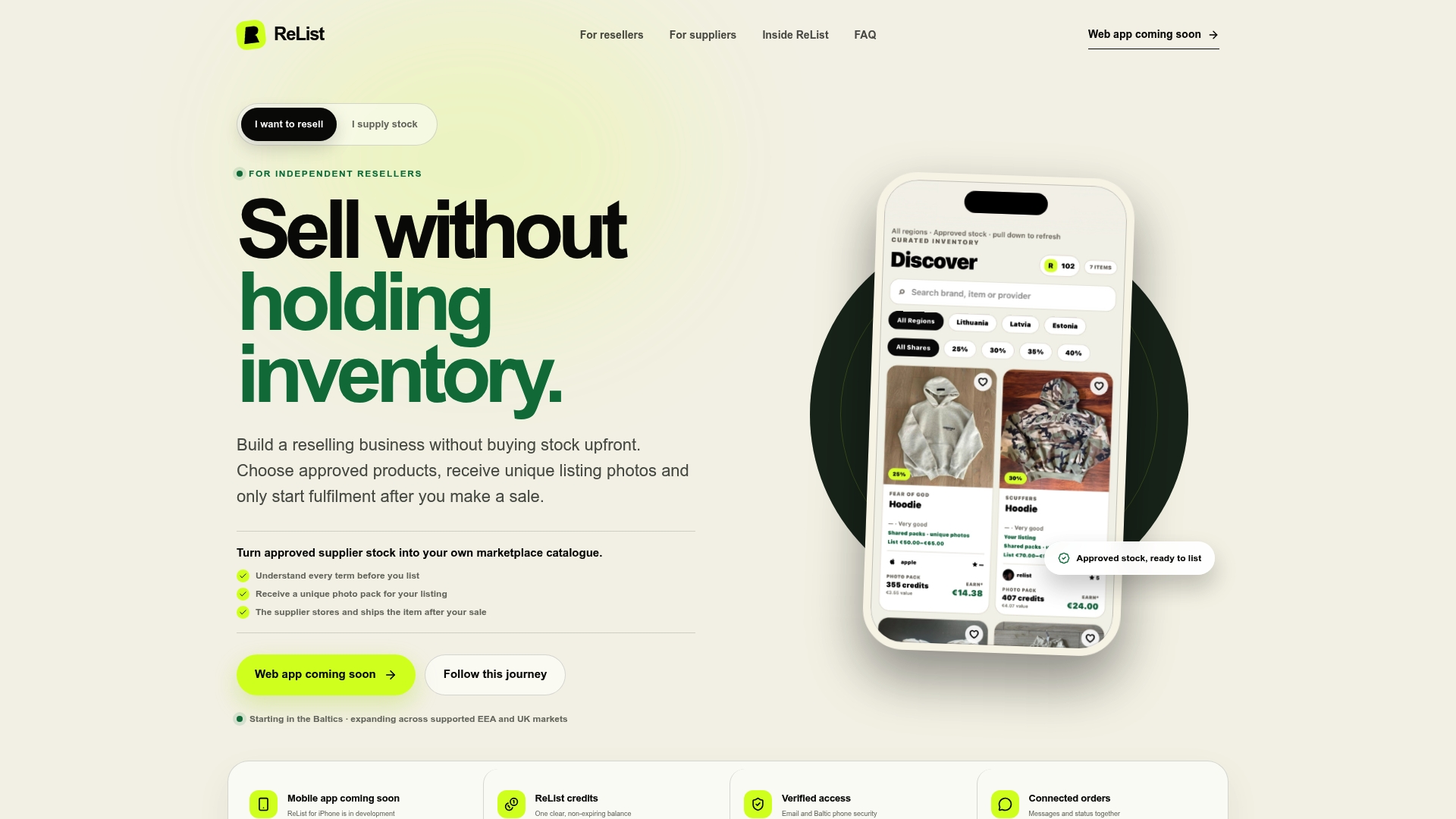
That structure fits directly into the testing cycle described above. Once a candidate clears your scoring matrix, you can list it on a platform that allows running an ad test without a wholesale order sitting in the background. If it scales, the supplier handles storage and shipping while you manage the customer relationship and order tracking through a real-time status view. If it doesn’t clear your CPA target, you’ve spent ad money learning, not capital sitting in unsold boxes.
This matters most when you’re testing several candidates from your weighted matrix in the same week, since spreading capital across inventory for three or four unproven products is exactly the kind of risk this whole system is built to avoid. Start by browsing ReList’s approved supplier catalog and listing your next scored candidate before you spend another dollar on stock you’re not sure will sell.
Sources
Running this system well means checking a handful of sources regularly rather than researching from scratch every time.
- Find trending ecommerce products: A repeatable workflow — Search Engine Land
- How to Find Winning Dropshipping Products — Branvas
- How to Find Winning Products — True Margin
FAQ
How Do You Find Out What Products Are in Demand?
Check a layered mix of signals rather than one source: cultural momentum on TikTok Creative Center and Pinterest, search momentum on Google Trends, and commerce confirmation through marketplace bestseller lists or order velocity data. A layered approach across cultural, search, commerce, and competitive signals catches real demand earlier than checking any single platform alone.
How Do You Find Winning Products on TikTok?
Use TikTok Creative Center’s trending hashtag and top ads sections, filtered by your category and sorted by recent performance rather than all-time views. Cross-check anything promising against Google Trends and a marketplace like Amazon before committing test budget, since TikTok engagement alone doesn’t confirm actual purchase intent.
How Do You Find Products That Are Selling Well?
Order velocity is the clearest signal: check whether a supplier listing’s recent order counts are climbing month over month, and confirm with multi-platform presence across Amazon, TikTok Shop, and AliExpress simultaneously. A product showing rising velocity on one platform but no presence elsewhere is a weaker signal than one confirmed across several.
How Do You Find the Best Dropshipping Products?
Run every candidate through margin, weight, demonstrability, and uniqueness filters first, then validate with search and commerce data, then score survivors with a weighted matrix covering trend momentum, demand, margin, saturation, and supplier risk. Platforms like Joinrelist let you list a validated candidate and test it without committing to inventory upfront, which lowers the cost of being wrong about any single pick.
What Ad Budget Do You Need to Test a New Product?
Between $50 and $200 per product across three to five distinct creative angles, with a decision made at the 48 to 72 hour mark based on cost per acquisition relative to your sell price. This range is large enough to generate a real signal without overcommitting to an unproven idea.
Made with BabyLoveGrowth to reach more people through search