
ReList journal
Resellers: 8 Step Multi Channel Dropshipping Workflow to Protect Margin

Multi channel dropshipping works, but only if you treat automation as a prerequisite, not an upgrade you’ll add later. Sellers who list on two or more marketplaces consistently outperform single-channel operators on revenue, and the gap comes down to systems, not luck. Start with a few channels that match your supplier’s actual shipping speed, centralize your inventory and order data before you add more channels, and vet suppliers on return handling before volume, not after a chargeback problem forces the issue.
TL;DR:
- Automating inventory sync, order routing, and price adjustments is essential before expanding to multiple channels to prevent oversells and margin losses.
- Prioritize channels that match your supplier’s delivery capabilities, starting with local or regional options before engaging faster-paced platforms like social commerce.
- Build a single source of truth for inventory and SKU mapping before adding new marketplaces to avoid costly mismatches and stay compliant with channel policies.
- Monitor key metrics such as inventory accuracy, order-to-ship time, and dispute rates weekly to catch issues early and maintain account health.
- Use a unified platform to streamline product discovery, listing, order management, and fulfillment, reducing errors, improving efficiency, and supporting scalable growth.
Table of Contents
- Which sales channels should you prioritize for multi-channel selling?
- Why does information flow break down across channels?
- What should you automate first when scaling across channels?
- How do you build a repeatable multi-channel dropshipping workflow?
- How do you vet suppliers and build a returns matrix?
- How do you set prices and optimize listings across platforms?
- Which KPIs matter as you scale multi-channel operations?
- How does a platform like ReList map to this workflow?
- What I’d tell someone starting from zero
- A simpler way to test products without carrying the risk
- Sources
- FAQ
Which sales channels should you prioritize for multi-channel selling?
Not every marketplace deserves your inventory feed on day one. Each channel has its own expectations for shipping speed, tracking uploads, and return windows, and mismatching those expectations is how new sellers get suspended.
Shopify gives you full control over branding and checkout, but you carry the entire traffic burden yourself. It’s the right home base for a store you want to own long-term, not a fast way to test a product.
Amazon remains the largest single opportunity by volume. Its third-party marketplace hit $575 billion in GMV in 2025, and that scale means faster discovery but also stricter delivery-time enforcement and higher account-risk sensitivity to late shipments.
eBay tolerates dropshipping in principle but polices it closely. Its third-party fulfillment policy requires that packaging and paperwork never mislead the buyer about who is actually shipping the order.
Niche marketplaces (Etsy, Wayfair, specialty verticals) offer less competition and often better margins, but lower search volume means slower validation of new SKUs.
Social commerce (Instagram/Facebook Shops, TikTok Shop) rewards fast-moving trend products but punishes slow fulfillment harder than any other channel, since buyers arrive with impulse-purchase expectations.
A simple prioritization rule: match the channel’s delivery promise to your supplier’s real capability. If your supplier ships from overseas with 10 to 15 day transit times, delay Amazon and social commerce until you’ve secured domestic or regional stock, and start on Shopify or a niche marketplace where buyers tolerate longer waits.

Why does information flow break down across channels?
The single biggest operational risk in multi-channel dropshipping isn’t a bad product. It’s data drifting out of sync between platforms until a customer orders something that no longer exists.
Three failure patterns show up constantly:
- Oversells: a supplier’s last unit sells on Amazon at 2:00 PM, but eBay still shows it in stock at 4:00 PM because inventory only synced once that morning.
- Stale pricing: a supplier raises cost by $3, but three of your five channels still reflect the old price, quietly eating your margin on every order.
- SKU mismatches: the same product carries different identifiers across platforms, so a return on eBay never reconciles against the original Shopify order.
The fix starts with a single source of truth. Run one centralized inventory feed that every channel pulls from rather than maintaining separate per-channel buffers, and set your available-to-sell number conservatively, a few units below true stock, to absorb sync delays. Automated low-stock and price-change alerts catch drift before it becomes a canceled order, and strict SKU mapping rules (one master SKU tied to every channel-specific listing ID) prevent the mismatch problem entirely.
Pro Tip: Build your SKU map before you list on a second channel, not after. Retrofitting SKU logic across an active catalog is one of the most time-consuming fixes in multi-channel reselling, and it’s entirely avoidable.
What should you automate first when scaling across channels?
You cannot manually update six channels every time a price shifts or an item sells out. Multichannel management systems exist specifically to close that gap, and the sellers who scale past a handful of SKUs almost always automate before they expand, not after.
Five automation areas matter most, roughly in this order:
- Inventory sync: real-time or near-real-time stock updates across every connected channel.
- Order routing: automatically sending each order to the correct supplier based on SKU, location, or cost.
- Tracking uploads: pushing carrier tracking numbers back to each marketplace fast enough to satisfy their delivery-confirmation windows.
- Repricing: adjusting listed prices based on competitor movement or landed-cost changes without manual review of every SKU.
- Listing localization (PIM): adapting titles, categories, and compliance fields to each platform’s format requirements.
Tool categories map fairly cleanly to these needs. Multichannel management platforms handle inventory and order sync across storefronts. Product information management (PIM) systems handle the catalog transformation problem, reformatting one product record into the field structure each marketplace demands. Order management systems (OMS) route and track fulfillment. Dedicated repricers watch competitor pricing and your cost floor simultaneously. iPaaS or middleware tools stitch together platforms that don’t natively integrate.
Mirakl’s seller data shows multi-market sellers generating roughly 17.5 times more GMV on average than single-channel sellers in its sample comparisons, and catalog automation is a large part of why: sellers who automate feed mapping onboard new channels in a fraction of the time it takes to build listings by hand.
When shortlisting a tool, check five things: full coverage of your target channels, native supplier integrations (not just generic API access), sync frequency measured in minutes rather than hours, clear error handling when a feed fails, and a defined SLA for how fast tracking numbers upload after a supplier ships.
How do you build a repeatable multi-channel dropshipping workflow?
A workflow only scales if every step has a clear decision point and a person or system responsible for it. Here’s the sequence that holds up under volume:
- Product discovery: vet the product against supplier lead time, not just demand data. A trending item with 20-day shipping will fail on fast-delivery channels regardless of margin.
- Feed and SKU mapping: assign a master SKU and map it to every channel-specific listing before the item goes live anywhere.
- Listing publication: push the listing to your first one or two priority channels, adjusting title and category fields per platform requirement.
- Order routing: define a primary supplier for each SKU and a failover supplier for out-of-stock situations, so an order never sits unrouted.
- Fulfillment handoff: confirm the supplier received the order and set an internal alert if confirmation doesn’t arrive within your defined window (commonly 4 to 12 hours).
- Tracking upload: push tracking numbers to the originating channel the moment the supplier provides them, since delays here directly trigger marketplace penalties.
- Returns processing: route the return per your supplier’s stated window and the channel’s own policy, documented in advance so support reps aren’t guessing.
- Reconciliation: run a daily check of orders shipped against orders confirmed, and a weekly check of inventory counts against actual supplier stock.
Pro Tip: Treat your daily reconciliation as a five-minute non-negotiable habit, not a weekly cleanup task. Catching one oversell same-day costs you an apology email; catching it a week later costs you a policy strike.
How do you vet suppliers and build a returns matrix?
Supplier quality determines almost everything downstream, from delivery speed to your account health score. Before committing volume to any supplier, check five things: average processing time from order to ship, how fast they upload tracking numbers, where their fulfillment centers are physically located, their history of disputes or defect claims, and how they perform on a small sample order you place yourself.

Warehouse location matters more than most new sellers assume. Suppliers offering guaranteed fast-ship windows, like CJ Dropshipping’s 72-hour ship-or-refund program, are resetting expectations across the industry in 2026, and local or regional warehousing sharply cuts delivery-related defect rates compared to overseas-only fulfillment.
Once you’ve selected suppliers, build a returns matrix: a simple table mapping each supplier’s return window against each channel’s required policy. eBay, for instance, expects a return process that doesn’t reveal third-party fulfillment or mislead buyers about who’s shipping the item, so document how packing slips and seller identification will comply before you list. Where a supplier’s return window is shorter than a marketplace’s required window, you absorb the gap, so price that risk into your margin rather than discovering it during a dispute.
How do you set prices and optimize listings across platforms?
Margin erosion in multi-channel dropshipping rarely comes from one bad decision. It comes from small pricing drift compounding across every channel you’re active on.
Start with landed cost per channel: supplier cost, plus channel fee, plus payment processing, plus any advertising spend attributed to that listing. Set your repricer’s floor at that landed cost plus your minimum acceptable margin, never below it, even to win a buy box. Use aggressive repricing on high-velocity, low-differentiation products where competing on price wins the sale; preserve margin on niche or branded items where buyers aren’t comparison-shopping as hard.
Listing optimization needs a per-channel checklist, not one description copied everywhere:
- Titles matched to each platform’s search algorithm (keyword-front-loaded on Amazon, more descriptive on Etsy).
- Category mapping verified against each marketplace’s current taxonomy, since misclassified items get suppressed in search.
- Returns copy that matches your actual supplier return window, not a generic policy pasted from a template.
- Images that meet each platform’s size and background requirements.
Monitor margin weekly, not monthly. Mirakl’s data on catalog automation shows that sellers who automate feed updates catch cost or fee changes fast enough to reprice before a full sales cycle erodes their margin.
Which KPIs matter as you scale multi-channel operations?
Scaling without metrics is how sellers find out about a problem only after a marketplace suspends their account. Track six numbers weekly at minimum:
- Inventory accuracy: percentage of listings matching true available stock; below 97% signals your sync frequency needs tightening.
- Order-to-ship time: hours between order placement and supplier confirmation; a rising trend means a supplier review is overdue.
- Tracking upload rate: percentage of orders with tracking uploaded within your target window; a drop here should trigger an immediate supplier conversation.
- Return rate: by channel and by supplier, since a spike isolated to one supplier points to a fulfillment or quality issue, not a demand problem.
- Dispute or defect rate: a leading indicator of account risk on Amazon and eBay specifically.
- Channel gross margin: net of fees and ad spend, tracked separately per channel since fee structures vary widely.
When testing a new channel, cap it at a small percentage of total SKUs first and monitor these same metrics in isolation before expanding, so one bad channel launch doesn’t distort your whole operation’s numbers.
How does a platform like ReList map to this workflow?
Every step in this playbook, product discovery, listing, order routing, fulfillment, and reconciliation, has a corresponding feature category, and a single-platform approach makes sense when it genuinely covers all of them rather than forcing you to stitch together three separate tools.
Here’s how the pieces line up in practice:
- Product discovery: choosing from a catalog of pre-approved supplier products removes the vetting burden this guide describes in the supplier section.
- Unique listing images: solves the duplicate-photo problem that hurts search ranking and buyer trust on marketplaces that penalize stock imagery.
- Order management: centralizes the order-routing and confirmation steps that otherwise require manual tracking across spreadsheets.
- Supplier-handled fulfillment: the supplier stores and ships after the sale, which removes the inventory-carrying risk this entire workflow is designed to manage.
- Real-time status tracking: covers the reconciliation habit this guide recommends running daily.
A single-platform approach makes the most sense when you’re testing new SKUs and want the workflow enforced by design rather than assembled from five separate subscriptions.
What I’d tell someone starting from zero
The three mistakes I see most: adding a third channel before the first two are actually synced, trusting a supplier’s promised ship time instead of testing it with a real order, and treating returns policy as an afterthought until a dispute forces the issue.
If I had to start over, my checklist would be short: one channel, one supplier you’ve personally tested, one inventory feed as the single source of truth, and a returns matrix built before the first sale, not after the first complaint. Everything else is expansion, and expansion only works once that foundation holds.
— Nikodemas
A simpler way to test products without carrying the risk
A platform like Joinrelist can help new resellers avoid carrying inventory before a product sells by enabling selection from approved supplier products, providing unique images for listings, and facilitating payment only after a sale, while the supplier handles storage and shipping.
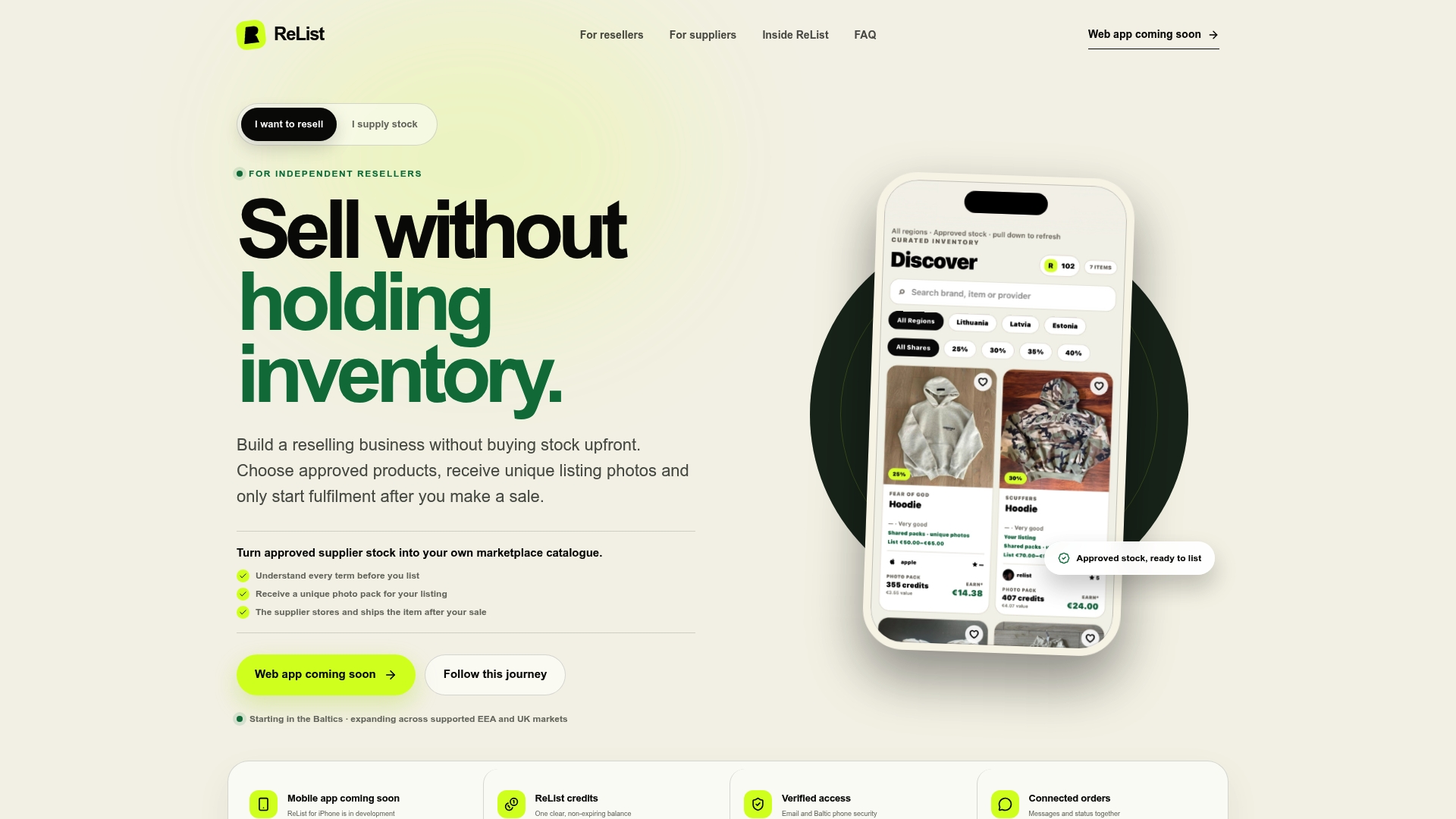
That structure matters most for sellers testing new SKUs across multiple channels, exactly the scenario where this guide recommends starting small and validating before you scale. Instead of sinking cash into stock for a product that might not move on a given channel, you list it, see if it sells, and let the transparent pricing and real-time status tracker handle the rest. If you’re weighing your next channel or your next SKU, start browsing ReList’s approved supplier catalog and list your first product without prepaying for stock.
Sources
- Reach Millions of Customers Across 450+ Channels | Mirakl
- Third-party fulfilment policy | eBay
- Using Multi-Channel Management to Overcome Drop Shipping Challenges
FAQ
How to make $10,000 a month dropshipping?
There’s no fixed formula, but the sellers who hit consistent five-figure months almost always run multiple channels with centralized inventory, not one storefront. Focus on margin per order and repeatable supplier reliability before chasing volume; a channel that generates sales but erodes margin through returns and disputes won’t get you there.
Is dropshipping dead in 2026?
No. Amazon’s third-party marketplace alone reached $575 billion in GMV in 2025, and multi-market sellers continue to outperform single-channel operators. What’s changed is tolerance for slow shipping and sloppy supplier vetting, not the model itself.
What is the best multi-channel ecommerce platform?
There isn’t one universal answer, since the right tool depends on which channels you’re prioritizing and whether you need inventory sync, order routing, or full fulfillment coordination. For resellers who want to avoid holding stock entirely, some platforms offer product discovery, listing images, and order management integrated in one place, reducing the need to stitch together separate tools.
Why do so many dropshippers fail?
Most failures trace back to information flow breaking down: oversells, stale pricing, and SKU mismatches that snowball once a seller adds channels faster than their systems can track them. Weak supplier vetting compounds the problem, since a slow or unreliable supplier creates disputes on every channel simultaneously rather than just one.