
ReList journal
Get a Sale in 1–3 Weeks: 6 Ways to Sell Without Inventory

Yes, you can sell without inventory, and it’s a legitimate way to start an online business today. The proven paths are dropshipping, print-on-demand, digital products, affiliate marketing, third-party fulfillment (like FBA), and curated reseller marketplaces. Most beginners do best starting with digital products or print-on-demand if they’re creators, or dropshipping if they just want to test whether a product sells. None of this erases your legal responsibilities around shipping, refunds, and disclosure. The obligations still land on you, not your supplier.
TL;DR:
- Digital products remain the highest-margin option, but require significant upfront effort in product creation and marketing.
- Dropshipping offers quick launch but yields thin profit margins and relies heavily on supplier fulfillment reliability.
- Print-on-demand suits creators prioritizing branding, with margins around 15% to 35%, but involves longer shipping times and quality checks.
- Reseller marketplaces and third-party fulfillment reduce daily logistics, but often require upfront stock investment and limit control over quality.
- Testing suppliers with a full order before launching is essential to avoid fulfillment issues and ensure smooth customer experiences.
Table of Contents
- What Are the Main Inventory-Free Selling Models?
- How Do You Actually Run Each Model?
- Which Model Wins on Cost, Margin, and Speed?
- How Do You Pick the Right Model and Vet Suppliers?
- What’s the Step-by-Step Path to Your First Sale?
- How Does ReList Support a No-Inventory Reselling Business?
- When Should You Stop Being Inventory-Free?
- Ready to List Your First Product Without Buying Stock?
- Where to Verify the Legal and Tax Details
- Sources
- FAQ
What Are the Main Inventory-Free Selling Models?
Six models cover almost every version of ecommerce without inventory, and each fits a different kind of seller.
Dropshipping means you list a product, a supplier ships it directly to your customer, and you never touch the item. It suits people who want to test demand fast across many products without upfront cash tied up in stock.
Print-on-demand (POD) puts your design on a blank product (shirts, mugs, phone cases) that gets printed only after a sale. It’s built for creators and artists who care more about branding than product variety.
Digital products — courses, templates, ebooks, presets — get sold and delivered automatically with zero shipping involved. This is the highest-margin model, and it fits people with existing expertise or an audience.
Affiliate marketing means you never sell anything directly. You send buyers to someone else’s checkout and collect a commission. It works well for people who already produce content: reviews, comparisons, tutorials.
Third-party fulfillment and FBA-style services let you send bulk stock to a warehouse that picks, packs, and ships for you. This isn’t fully inventory-free (you still own the stock), but you skip the daily fulfillment grind.
Reseller marketplaces, including platforms built specifically for this model, let you list supplier-approved products and only pay once you’ve made the sale. Fulfillment routes through the supplier automatically.
The trade-offs move in a predictable direction: the less physical involvement you have, the lower your margin usually runs, and the less control you have over quality and delivery speed.
How Do You Actually Run Each Model?
Each of these models has its own mechanics, and skipping the details is where most new sellers lose money in month one.
1. Dropshipping: fast to launch, thin on margin
You find a supplier (often through a directory or app), pull product data and images, and list items in your own store. Margins typically run 10% to 30% after supplier costs, ad spend, and platform fees eat into the sale price. The single biggest failure point is fulfillment: a supplier that ships late or sends the wrong item damages your store’s reputation, not theirs, because buyers frequently can’t tell the difference between the platform and the third-party seller behind it. Order a sample yourself before listing anything. Time to first sale usually runs one to three weeks once a store and ad account are live.
2. Print-on-demand: slower margins, stronger brand equity
POD sellers design products, upload artwork to a print partner, and let the platform handle production and shipping per order. Margins land in a similar 15% to 35% range depending on the product category and print costs. The extra step that matters here: order a proof of every design before it goes live, because color and placement often shift between screen and print. Shipping times run longer than dropshipping (often one to two weeks for production plus transit), and customs delays are common if your print partner operates overseas.
3. Digital products: the best margins, the most upfront work
Ebooks, templates, and courses cost nothing to duplicate, so margins after payment processing fees often exceed 70%. The catch is that you do all the work before the first sale. Platforms handle delivery automatically, and pricing usually follows either a one-time fee or a tiered model based on access level. Launch mechanics matter more here than fulfillment logistics: a waitlist or presale period before public launch tends to outperform a cold launch.
4. Affiliate marketing: content first, sales second
This model fits people who already publish content. You join a network or program, insert tracked links into reviews, tutorials, or comparison posts, and earn a commission per sale or lead. It works best in product categories where buyers research heavily before purchasing (electronics, software, home goods). Disclosure isn’t optional. The FTC requires clear, conspicuous statements when you have a financial relationship with a brand you’re recommending, and burying it in a footer doesn’t count.
5. Third-party fulfillment and marketplaces: less hands-on, less control
Warehouse fulfillment services and curated reseller marketplaces both remove the daily shipping burden, but they do it differently. Fulfillment warehouses require you to buy stock upfront and ship it in bulk, trading cash outlay for speed and consistency. Marketplace models built for resellers flip that: you list approved products, and the supplier only ships after a sale closes, so you’re never holding cash in stock that hasn’t moved. Marketplace rules also dictate what information you must display to buyers, and larger platforms are increasingly required to verify high-volume sellers under the INFORM Consumers Act.
Pro Tip: Whatever model you pick, place one real order through your own store before you launch publicly. Confirming tracking, delivery time, and the return process yourself catches most fulfillment problems before a customer ever does.

Which Model Wins on Cost, Margin, and Speed?
No single model wins across every category, which is exactly why picking one requires knowing your priority first.
- Startup cost and cash risk: Digital products and affiliate marketing carry close to zero financial risk. Dropshipping and POD need only small sample-order spending. Warehouse fulfillment requires the most upfront cash since you’re buying stock in bulk.
- Typical gross margin: Digital products lead by a wide margin, often 70% or higher. POD and dropshipping trail behind at 10% to 35%. Affiliate commissions vary wildly by industry, from a few percent to over 30% on digital services.
- Control over quality and fulfillment: Warehouse fulfillment gives you the most control since you chose the stock. Dropshipping gives you the least, since you rarely see the product before a customer does.
- Time to first sale: Affiliate marketing and reseller marketplaces tend to move fastest since there’s no product creation step. Digital products take longest because you build the product before you can sell it.
- Scalability and catalog breadth: Dropshipping and reseller marketplaces scale catalog size easily since adding a product means adding a listing, not buying stock.
If you’re testing an idea, dropshipping or a reseller marketplace gets you data fastest. If you’re building a brand people remember, POD or digital products earn that loyalty better than a catalog of items anyone else could sell.
How Do You Pick the Right Model and Vet Suppliers?
Five questions decide whether a model fits your situation, and none of them are about which one sounds most exciting.
- Audience fit: Do the people who’d buy from you want variety (dropshipping, marketplaces) or a specific creative product (POD, digital)?
- Margin math: After supplier cost, platform fees, and ad spend, does the number left over justify your time?
- Fulfillment service levels: Can the supplier commit to a shipping window you’re willing to guarantee to customers?
- Returns and warranties: Who eats the cost of a damaged or wrong item, you or the supplier?
- Branding and customization: Can you differentiate the product, or are you selling the exact same item as a hundred other stores?
Before signing up with any supplier, ask directly: What’s your average lead time from order to shipment? Can I order a sample before listing? What’s your return policy, and who initiates it? Do you carry shipping insurance? Can I track orders in real time? How do I reach someone if a shipment goes wrong?
Watch for suppliers who dodge specifics on lead time, refuse sample orders, or have no real customer service contact. Pro Tip: Hold off on running paid ads to any new supplier’s product until you’ve completed one full test order yourself. It’s the cheapest insurance you’ll ever buy against a bad launch.
What’s the Step-by-Step Path to Your First Sale?
- Validate demand using marketplace search data, keyword volume, or a small paid ad test before building anything.
- Pick your model and niche, then build a minimal product listing with pricing that leaves real margin after fees.
- Set up your storefront and payment processing, then connect your fulfillment partner or delivery pipeline.
- Order a sample and run the full checkout-to-delivery flow yourself, and publish clear shipping and refund pages.
- Launch on one marketing channel, measure results, and refine your product page and fulfillment before adding a second channel.
How Does ReList Support a No-Inventory Reselling Business?
Some reseller platforms are built for resellers who want to skip the inventory step entirely. They allow browsing supplier-approved products, provide unique photos for each listing to improve store differentiation, and let you pay for an item only after it sells. Order management, supplier communication, and real-time status tracking often live in one workspace, which helps avoid piecing together spreadsheets and email threads to track orders.
This fits resellers who want product variety without warehouse risk, and creators who’d rather spend time on listings than logistics. A sensible first move is to browse the available catalog, request sample photos, and run one test order through to delivery before scaling listings. It’s the same fulfillment test any smart seller should run regardless of platform, ideally applied with a supplier network that has been vetted.

When Should You Stop Being Inventory-Free?
The honest answer: once your margins can absorb the cost of owning stock and you’ve proven repeat demand for specific products. Most stalled stores don’t fail from bad marketing. They fail from margin erosion as ad costs climb, supplier turnover that breaks fulfillment promises mid-quarter, and customer service loads that outgrow a solo founder’s time. Start lean, prove the unit economics hold up, then reinvest in exclusive supply or owned inventory once the numbers justify it.
— Nikodemas
Ready to List Your First Product Without Buying Stock?
Every model above asks you to either front cash for stock, build a product from scratch, or hand your sales to someone else’s platform for a commission. Some platforms take a different route: you list supplier-approved products with unique photos, and pay for items only after a customer has already bought them. That flips the usual startup risk on its head. No warehouse, no upfront purchase order, no guessing whether a product will move before you’ve paid for it.
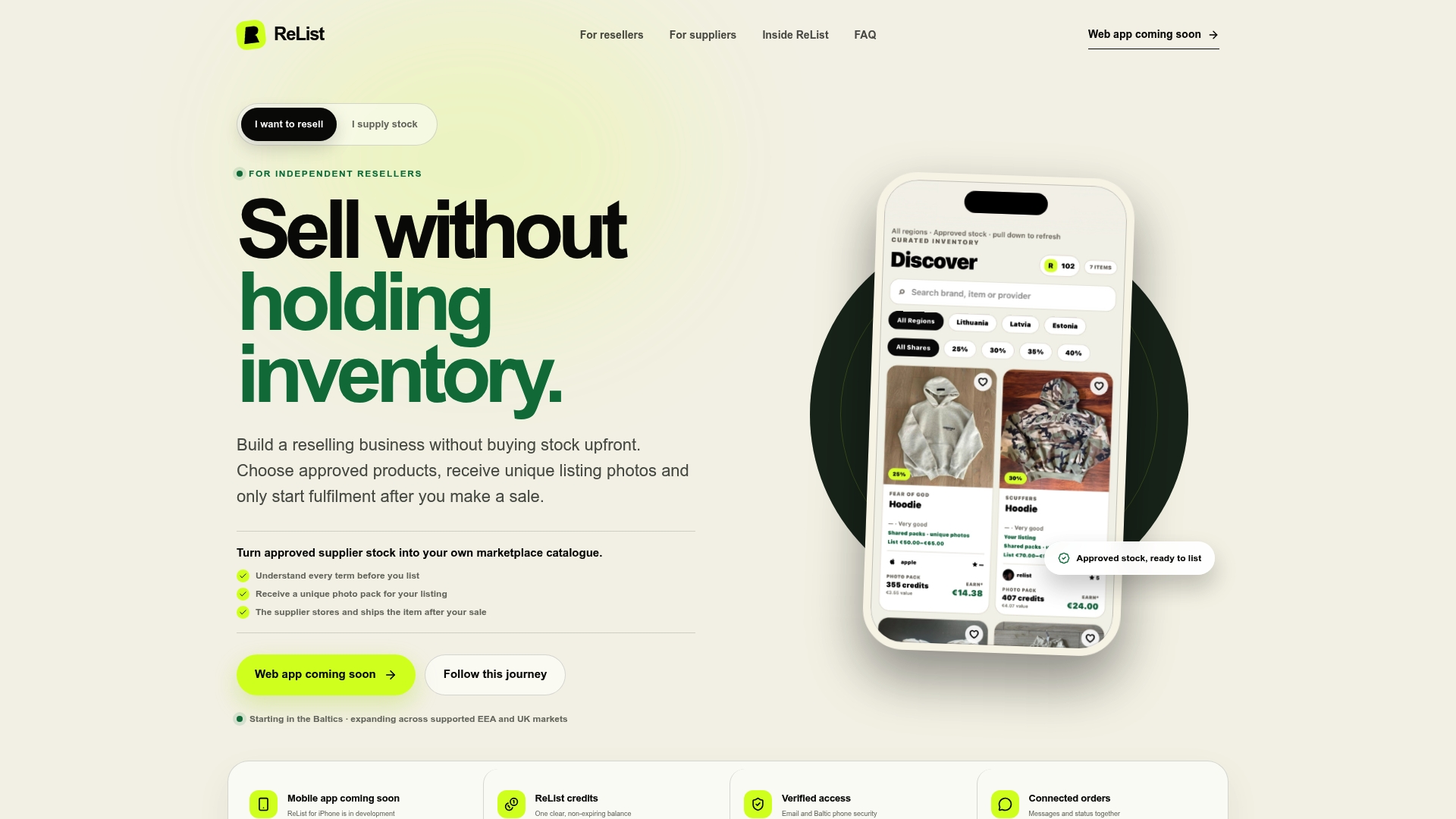
The order management, supplier messaging, and real-time status tracking all sit in one place, so you can see exactly where a sale stands without chasing updates across email and spreadsheets. If you’re ready to test this out, start browsing ReList’s supplier catalog and request a sample photo pack for your first listing.
Where to Verify the Legal and Tax Details
For shipping and refund obligations, read the FTC’s Mail, Internet, or Telephone Order Merchandise Rule. For marketplace disclosure requirements, check the INFORM Consumers Act guidance. For tax reporting thresholds on payment platforms, review the IRS Form 1099-K instructions.
Sources
- Informing Businesses about the INFORM Consumers Act | Federal Trade Commission
- Instructions for Form 1099-K (12/2026) | Internal Revenue Service
- How To Start an Online Store Without Inventory (2026) - Shopify
FAQ
How can I make money on Amazon without holding inventory?
You can sell on Amazon without inventory through dropshipping (where a supplier ships directly to the buyer) or by using Fulfillment by Amazon after sending bulk stock to their warehouse, which removes daily fulfillment work but still requires you to purchase the stock upfront. Both routes still make you responsible for shipping timelines and refunds under the FTC’s mail-order rule.
What products are easiest to sell without inventory?
Lightweight, non-fragile items with stable demand tend to work best for dropshipping and print-on-demand, since they’re cheaper to ship and less prone to damage in transit. Digital products like templates, presets, and guides are technically the easiest since there’s no physical shipping at all.
How do I get rid of unsold inventory?
If you’re already holding stock, options include discounting through your own channels, listing on liquidation marketplaces, or bundling slow movers with bestsellers to clear space. The better long-term fix is shifting future product lines toward inventory-free models like dropshipping or a reseller platform like ReList, where you never buy stock that might not sell.
What’s the easiest type of product to resell?
Products with established demand and a reliable supplier track record are easiest to resell, since you’re not spending months building a customer base for something unproven. Platforms that supply pre-vetted products with ready-made listing photos, such as ReList, remove much of the sourcing guesswork that trips up new resellers.
Do I still need to worry about refunds if a supplier ships my orders?
Yes. Under the FTC’s mail-order rule, you as the merchant must offer a refund or delay option if an order can’t ship within the promised window, even when a third party handles fulfillment. That responsibility doesn’t transfer to your supplier just because they’re the ones packing the box.