
ReList journal
Earn $100–$500/Month Reselling: Test the Side Hustle Without Inventory

Yes, reselling can turn into a legitimate side hustle if you sell items with proven demand, track your real profit after fees, and treat sourcing like a skill instead of a hobby. Realistic outcomes range from $100 to $500 a month for casual sellers testing the waters, up to nearly $9,000 in a first year for someone who treats it seriously and sells hundreds of items. Start small: source and list a few items before you invest more money.
TL;DR:
- Focusing on fast-selling items with high sell-through rates, such as clothing, toys, and electronics accessories, increases cash flow and reduces inventory holding time.
- Checking sold listings and sell-through rates before purchasing items prevents buying slow-moving stock that erodes profit and ties up cash.
- Achieving a consistent net profit of at least $5 to $10 per item or $300 monthly goal requires disciplined tracking of fees, costs, and earnings across a few categories.
- No-inventory platforms like ReList can eliminate upfront stock costs by outsourcing storage and shipping, suitable for part-time sellers with limited space.
- Maintaining a specific profit goal and time investment plan helps avoid burnout and optimizes reselling as a sustainable side hustle.
Table of Contents
- Why Reselling Side Hustle Success Depends on Speed, Not Sticker Price
- How to Start Reselling for Beginners in a Single Weekend
- Where to Find Inventory and Confirm It Will Actually Sell
- The Real Profit Math Behind Every Sale
- Managing Your Time Without Burning Out
- Taxes, Returns, and the Ethics of Bulk Buying
- How No-Inventory Fulfillment Changes the Reselling Equation
- What I’ve Learned Watching Resellers Win and Quit
- Try a Low-Risk Way to Test Reselling Without the Inventory Risk
- Where to Learn More Before You Start
- Sources
- FAQ
Why Reselling Side Hustle Success Depends on Speed, Not Sticker Price
The resellers who make real money aren’t necessarily finding the priciest items. They’re finding items that sell fast, at a predictable price, over and over. A $15 item that sells in three days beats a $150 item that sits for four months, because your money and shelf space stay locked up the whole time it waits.
Low-startup categories worth testing include name-brand clothing, kids’ toys and gear, sneakers, and small electronics accessories. These move quickly because demand is constant and buyers already know what they’re looking for. One Business Insider profile of a reseller scaling from found and gifted items into a six-figure business shows how far disciplined comp research can stretch a near-zero starting budget.
Most beginners fail for the same handful of reasons:
- Skipping sold-listing research and guessing at price instead of checking what actually sold
- Ignoring platform and shipping fees until profit disappears
- Overbuying inventory that looked good in a thrift store but has no real buyer demand
- Underestimating the time cost of photographing, listing, and packing every item
Not everyone sticks with it, either. Some sellers walk away after realizing the lifestyle and time drain doesn’t match their goals, which is a fair reason to quit as any financial one.
How to Start Reselling for Beginners in a Single Weekend
Set a real number before you buy anything. A goal like $300 a month at five hours a week is specific enough to guide decisions; “make some extra money” is not. Pick one or two categories to test first, since spreading across ten categories on day one just multiplies your learning curve.
- Choose your categories. Clothing and shoes move fast but require sizing and condition knowledge. Electronics and collectibles carry higher margins but slower turnover.
- Build a simple workflow. You need a phone camera, a tape measure, an account on your chosen platform, and a habit of checking sold comps before every listing.
- Run the weekend test. Source two to five items on day one. Research sold prices and write titles and descriptions on day two. List everything, then ship as orders come in.
- Measure three things. Track your actual profit after fees, your total hours worked, and how many items sold versus how many you listed.
Pro Tip: Don’t buy anything until you’ve checked sold listings for that exact item. A $40 asking price means nothing if the last five sold for $18.
Where to Find Inventory and Confirm It Will Actually Sell
Inventory hides in more places than most beginners expect. Thrift and charity shops remain the classic entry point because turnover is high and prices are low, but garage sales, estate sales, retail clearance racks, online arbitrage (buying discounted items on one site to resell on another), and wholesale liquidation bundles all work too, each with a different balance of cost and time.
Sourcing without checking demand first is how garages fill up with unsellable stock. Before buying, pull sold listings on your phone: search the item on eBay, filter to “Sold Items,” and scan the last 10 to 15 completed sales for price and how recently they sold.

That sold data feeds directly into sell-through rate, or STR, which is simply sold listings divided by total listings for that item. STR is one of the highest-leverage numbers in reselling because it tells you speed, not just price. An item with a 50% or higher STR is moving fast and worth sourcing aggressively. Anything under 25% is a slow mover, even if the sold price looks attractive on paper.
Category signals matter too:
- Clothing: check brand tags, fabric condition, and whether the season matches your selling window
- Electronics: confirm the item powers on and includes cables or accessories buyers expect
- Toys and collectibles: original packaging and completeness often double the resale value
Checking STR before you buy, rather than after you’ve already listed a dud, is the single habit that separates profitable sourcing trips from expensive ones.
The Real Profit Math Behind Every Sale
The profit formula that actually matters is: Sale price minus platform fees minus payment processing minus shipping cost minus packaging supplies minus your cost of goods equals net profit.
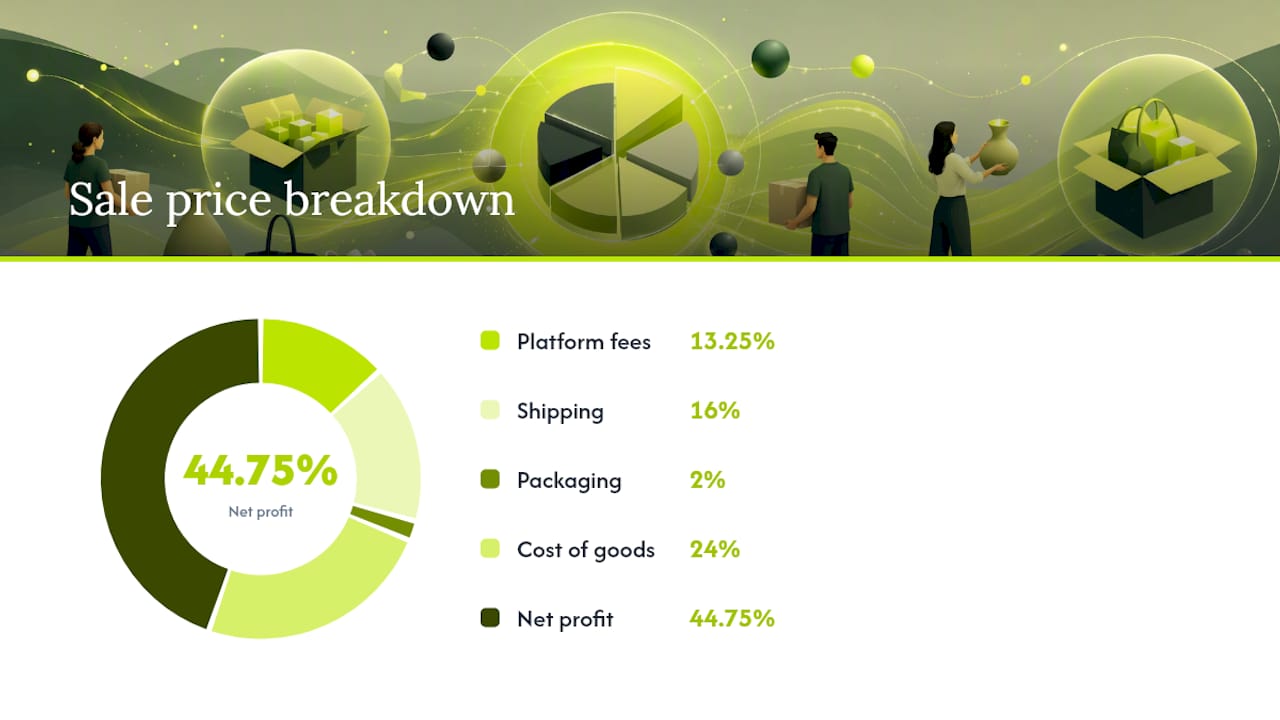
Here’s a real example. You sell a jacket for $50. eBay’s final value fee runs around 13.25% on the sale, so that’s roughly $6.63. Shipping costs $8, packaging materials run $1, and you paid $12 for the jacket at a thrift store. Net profit: $50 minus $6.63 minus $8 minus $1 minus $12, which leaves $22.37, before you count the time spent listing and packing it.
Fee structures vary by platform and change your math significantly:
- eBay charges a variable final value fee around 13.25% on most categories
- Poshmark charges a flat 20% on any sale of $15 or more
- Fees can flip a borderline item from profitable to a loss if you don’t check them first
Set a minimum profit threshold before you buy: at least $5 to $10 net for small, easy-to-ship items, and $20 or more for anything bulky or fragile enough to eat into your time. Track net profit per item in a simple spreadsheet. Without that record, it’s nearly impossible to know which categories are actually paying you.
Managing Your Time Without Burning Out
A sustainable weekly rhythm usually looks like two to three hours sourcing, two hours photographing and listing in a batch, and one to two hours packing and shipping orders. Batching listings, photos, and shipping runs separately, instead of doing all three every single day, is what keeps this from eating your entire week.
- Calculate your hourly equivalent by dividing total monthly net profit by total hours worked.
- If that number sits below minimum wage in your area after three months, your sourcing or pricing strategy needs to change, not just your effort level.
- Consider outsourcing shipping, switching to less time-intensive categories, or moving to a no-inventory model once sourcing and packing consume more hours than the profit justifies.
Taxes, Returns, and the Ethics of Bulk Buying
Returns, buyer disputes, and the occasional item that never sells are real costs of doing business.
There’s also a fairness question worth sitting with: buying out entire clearance shelves or thrift racks can strip inventory from people who need those items at that price, not just other resellers. Buy what you can realistically move, not everything cheap in sight.
On taxes, the rules are straightforward even if the paperwork feels new. If you sell through marketplaces or payment apps, you may receive Form 1099-K, and you’re required to report all taxable income regardless of whether you receive that form. A basic risk checklist:
- Keep receipts and sold-listing screenshots for every purchase
- Buy conservatively until your sell-through rate proves a category out
- Set aside a cash reserve for both returns and estimated taxes
How No-Inventory Fulfillment Changes the Reselling Equation
Holding inventory is the part of reselling that quietly drains cash and closet space before a single sale happens. A no-inventory model removes that step entirely: you list items using supplier-provided photos, and the supplier stores and ships the product only after it sells.
That structure changes what a reseller actually needs to succeed:
- No upfront cash tied up in unsold stock sitting in a garage
- Unique listing photos supplied for you, cutting the photography workload
- Order status tracked in one place instead of juggling spreadsheets and shipping labels
- Fulfillment handled by the supplier, so packing and mailing aren’t on your plate
This setup tends to fit part-time sellers with limited storage space or limited hours best, since the labor of packing and shipping disappears. A fair test: source and flip one or two traditional items the way you always have, then list one item through a no-inventory platform like ReList and compare your net profit against your actual hours spent on each.
What I’ve Learned Watching Resellers Win and Quit
The operational advice above holds up because it comes from watching patterns repeat: sellers who check sold comps before buying tend to survive their first six months, and sellers who skip that step tend to quit with a garage full of unsold stock. One reseller who tracked her numbers carefully turned roughly 470 sold items into close to $9,000 in profit her first year, working it around a full-time job. The lesson she’d probably repeat: sourcing without checking demand first is the single most expensive mistake in this business. Reselling rewards people who treat it like a small operation with real numbers, not a weekend treasure hunt.
— Nikodemas
Try a Low-Risk Way to Test Reselling Without the Inventory Risk
Everything covered above — sourcing trips, sold-comp research, packing, and shipping — takes real time and real cash sitting in inventory before you see a dollar back. ReList removes the inventory side of that equation: you pick from approved supplier products, get unique photos for your listings, and only pay for an item after it actually sells. The supplier handles storage and shipping, so your time goes into listing and customer communication instead of packing boxes in your garage.
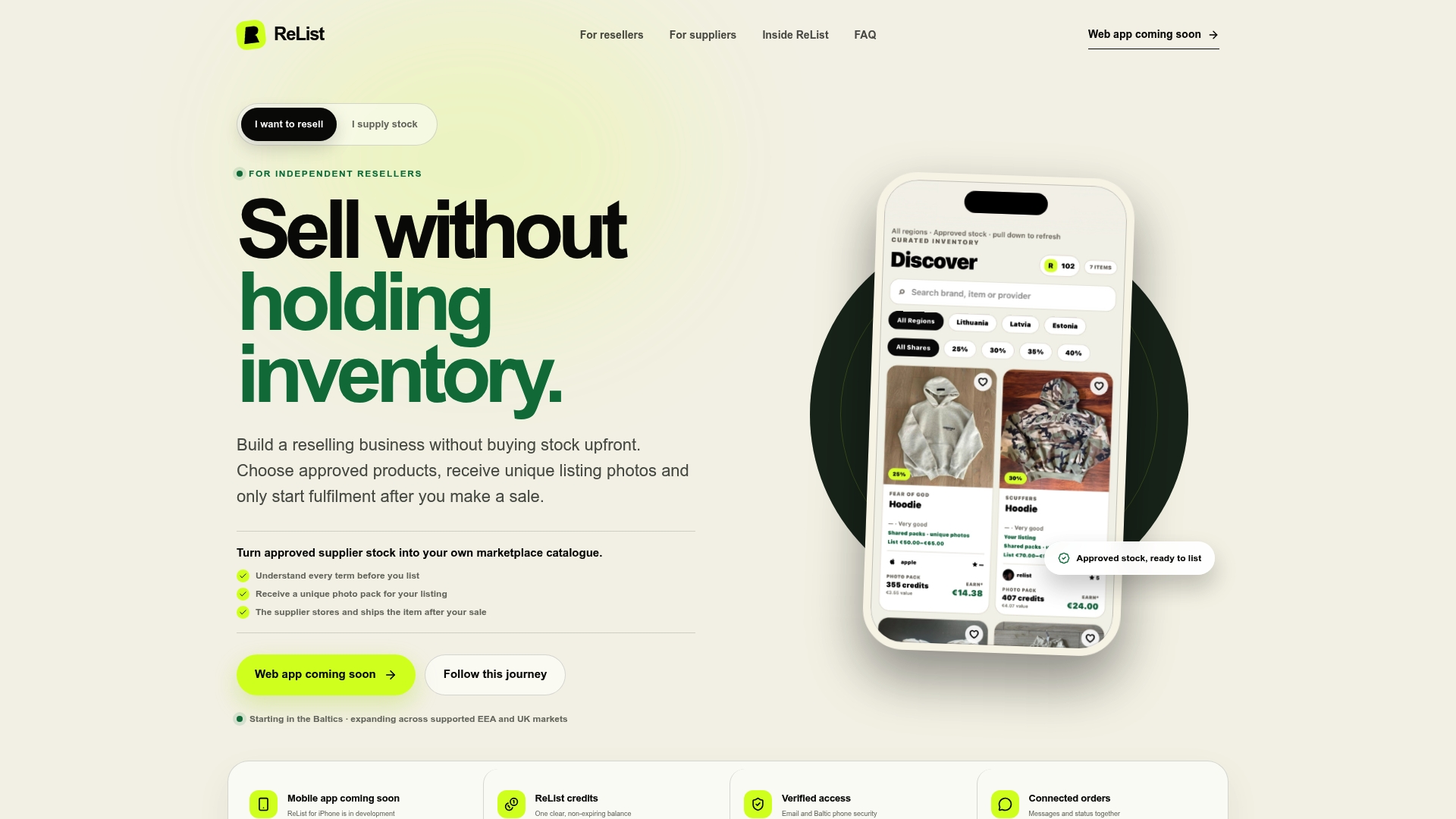
If you’re weighing whether a traditional flip or a no-inventory listing makes more sense for your schedule, run both side by side for two weeks and compare your net profit against hours spent. Check ReList’s platform to see how the listing and fulfillment workflow works before you commit any cash to inventory.
Where to Learn More Before You Start
For tax questions, the IRS page on Form 1099-K explains exactly where marketplace income gets reported. For sourcing and pricing, the sold-listings and sell-through rate guide walks through comp research in detail, and the reseller profit calculator guide breaks down fee math by platform.
Sources
- What to do with Form 1099-K | Internal Revenue Service
- My side hustle made nearly $9K in first year; I like the flexibility | Business Insider
- Underpriced
- Reseller Profit Calculator | Calculate Your Real Profit on Every Sale | Underpriced AI
FAQ
Is Reselling a Good Side Hustle?
Yes, for people willing to research demand before buying and track profit after fees rather than just revenue. Realistic results range from a couple of hundred dollars a month for casual sellers to nearly $9,000 in a first year for someone selling consistently and tracking their numbers.
How Do I Make $1,000 a Week Reselling?
Reaching high weekly earnings generally requires either high sales volume of low-margin items or a smaller number of higher-margin items with a proven sell-through rate above 50%. It rarely happens in month one; most sellers build toward that pace over several months of sourcing and listing experience.
How Can I Make $2,000 a Month Reselling on the Side?
That target typically means listing and selling several dozen items a month, depending on your average profit per item after fees and shipping. Focusing on categories with strong sell-through rates, rather than just high price tags, gets you there faster than chasing rare, slow-moving finds.
What Is the Most Profitable Thing to Resell?
There’s no single best item since profitability depends on your local sourcing costs and current demand, but categories with consistent sold-listing activity, like name-brand clothing, sneakers, and small electronics, tend to outperform trendy or seasonal items. Checking current sold comps before buying beats relying on any general “best items” list.
Do I Have to Pay Taxes on Reselling Income?
Yes. All income from reselling is taxable regardless of whether you receive a Form 1099-K from a marketplace or payment app. Keep records of your purchases and sales throughout the year so reporting is straightforward at tax time.