
ReList journal
7 Steps to Launch a Zero Upfront Cost Listing for Resellers

Zero upfront cost means you list products you don’t own, and you only pay the supplier after a customer pays you. You avoid buying inventory, but you inherit every fulfillment and customer service problem that comes with someone else’s warehouse. The upside is real: almost no capital barrier to testing a product line. The catch is operational, not financial, and platforms like ReList exist to manage exactly that gap.
TL;DR:
- Most dropshipping suppliers may have stock issues, longer shipping times, or inconsistent fulfillment which can lead to customer dissatisfaction if not carefully managed.
- Resellers should thoroughly vet suppliers by ordering multiple samples, verifying supply commitments, and tracking key metrics like fulfillment and return rates monthly.
- Starting with a small catalog and ordering samples before listing products helps ensure quality and avoids operational surprises down the line.
- The model is best suited for testing new categories or limited capital entrepreneurs but may require shifting to stock inventory once sales stabilize.
- Using platforms like ReList simplifies managing supplier relationships, listing, and order tracking, reducing manual work and improving transparency in fulfillment.
Table of Contents
- What Does Zero Upfront Cost Actually Mean for Resellers?
- How Does the Zero Upfront Cost Fulfillment Flow Work?
- What Are the Benefits and Tradeoffs of Zero Upfront Cost Selling?
- How Do You Start Your First Zero Upfront Cost Listing?
- How Do You Vet Suppliers for a Zero Upfront Cost Business?
- Who Actually Benefits Most From Zero Upfront Cost Selling?
- Try ReList for Your Next Zero Upfront Cost Listing
- Where to Learn More Before You List Your First Product
- Sources
- FAQ
What Does Zero Upfront Cost Actually Mean for Resellers?
The term gets thrown around loosely, but the mechanism behind it has a name: dropshipping. A supplier owns the physical stock. You list it, market it, and price it. When someone buys from you, you forward that order to the supplier, who packs and ships it directly to your customer. You pay the supplier’s cost after you’ve already collected the customer’s payment, not before.

That sequencing is the entire point. Traditional retail asks you to guess demand, buy stock, and hope it sells before the money runs out. Zero upfront cost flips that risk. You’re not gambling on inventory anymore. You’re gambling on operations: can the supplier ship on time, does the product match the photos, will returns eat your margin. Independent resellers often underestimate how much of that operational load lands on them, since the customer sees you as the seller no matter who packed the box.
How Does the Zero Upfront Cost Fulfillment Flow Work?
Money and product move in a specific order, and understanding that sequence tells you where things break. Here’s the typical path:
- You list the product. You set your price using photos and details from an approved supplier catalog, without ever holding physical stock.
- A customer buys and pays you. This payment lands in your account first, before you owe the supplier anything.
- You forward the order to the supplier. This step can be manual or automated depending on the platform you use.
- You pay the supplier their wholesale cost. This happens after you’ve collected the customer’s payment, which is the core mechanic that makes the model zero upfront.
- The supplier packs and ships directly to your customer. You never touch the product.
- You handle customer communication throughout. Shipping questions, delays, and return requests all come to you, even though you don’t control the warehouse.
There are variants worth knowing. A single-supplier dropship setup is simplest but riskiest: one delay or stockout and you have no plan B. A wholesaler model often means slightly better pricing and more reliable stock, but longer minimum order cycles for anything beyond drop-ship terms. Dual-channel or backup-sourcing setups, where you qualify two suppliers for the same product, cost a little more in vetting time but protect you when one supplier runs out. Shopify’s fulfillment documentation breaks down how wholesalers and manufacturers differ in lead time and minimum order behavior, which matters when you’re choosing who to route orders through.
Risk concentrates at three points: whether the item is actually in stock when ordered, how long shipping really takes versus what’s advertised, and what happens when a customer wants to return something a supplier already shipped.
What Are the Benefits and Tradeoffs of Zero Upfront Cost Selling?
The financial case is straightforward. You test products without tying up cash in stock that might not sell, and you can add or drop SKUs from your catalog in a day instead of a season. Academic research on drop-shipping arrangements confirms the mechanism: the model shifts inventory risk away from the retailer and onto the supplier, which is precisely why capital requirements drop so sharply for the reseller side of the supply chain.
That risk transfer isn’t free, though. Here’s what you’re trading away:
- Margin pressure. Supplier wholesale pricing plus your fees often leaves thinner margins than buying in bulk would.
- Supplier dependence. Your reputation rides on someone else’s shipping speed and packing quality.
- Shipping variability. Delivery windows can shift without warning, and you’re the one explaining it to the customer.
- Returns exposure. You may need to manage a return even when you never physically had the item.
The tradeoff in one line: you’re not paying for inventory anymore, but you’re paying with attention. Overpromising on availability is one of the most common failure points in these arrangements, and operational research on commitment policies shows that resellers who set conservative, tested availability windows avoid far more fulfillment failures than those who trust supplier claims at face value.
The practical fix is proactive customer service and honest shipping copy on every listing, not after a complaint arrives.
How Do You Start Your First Zero Upfront Cost Listing?
Launching your first listing takes less time than most resellers expect, but skipping steps here is where new sellers get burned. Work through this in order:
- Read the supplier’s terms before you list anything. Confirm lead times, restock behavior, and exactly how returns are routed.
- Order samples of every product you plan to sell. Inspect quality and time how long shipping actually takes against what’s promised.
- Calculate your landed cost. Add supplier price, platform fees, shipping, and a reserve for returns, then set your margin from that total, not the sticker price alone.
- Set up SKUs and order routing. Manual order forwarding works for five products; it breaks down fast at fifty.
- Write your shipping and return policy in plain language. State delivery windows and who to contact for issues before a customer ever asks.
- Draft response templates for delays and returns. Have them ready before your first sale, not after your first complaint.
- Track fulfillment time and return rate from day one. These two numbers tell you faster than revenue whether a supplier relationship is working.
Pro Tip: Order the same product twice, a few weeks apart, before you commit to it long term. A single sample tells you about quality. A second one, ordered later, tells you whether that quality holds up when the supplier is busy.
Consumer protection guidance is worth reading here too. Regulators increasingly expect accurate delivery and return information disclosed up front, not buried in a support ticket after the sale, according to the ACM’s dropshipping checklist.
How Do You Vet Suppliers for a Zero Upfront Cost Business?
Vetting is the highest leverage work you’ll do in this model, and most resellers skip it. A practitioner rule worth adopting: order three different SKUs from the same supplier as samples, spaced at least two separate times, to catch intermittent stock or packaging problems a single order would miss. Review low-star complaint patterns before you list anything, since chronic quality issues almost always show up in reviews before they show up in your own orders.
Beyond samples, build these controls into your process:
- Verify shipping and refund SLAs in writing, not just in a sales call.
- Ask suppliers directly about backup availability if their primary stock runs low.
- Require committed availability numbers, since research on fulfillment commitment policies finds that unverified availability claims are one of the most common causes of missed orders.
- Set penalty terms for late shipments where the supplier relationship allows it.
Track four numbers monthly: fulfillment time, on-time rate, return rate, and customer response time. A supplier that slips on any one of these consistently is a supplier you replace, not tolerate.
This is where a platform’s built-in tooling earns its keep. ReList’s approach includes unique listing photos for each product, so your catalog doesn’t look identical to every other reseller carrying the same item, along with a real-time status tracker so you can see order progress without emailing a supplier to ask. The platform’s transparent pricing model means you know your cost and fee structure before you commit to a listing, not after a surprise deduction. These are the vendor’s own stated features, worth evaluating directly against your own vetting checklist rather than taking at face value.
Who Actually Benefits Most From Zero Upfront Cost Selling?
Zero upfront cost is a strong fit for testing new product categories, running a small catalog while you learn what sells, or starting a business with limited capital. It’s a poor fit if you need tight brand control, sell in a category with heavy return rates, or operate on margins too thin to absorb a supplier’s occasional shipping delay.
Watch for the signal that tells you it’s time to graduate. Consistent, repeatable sales on a specific SKU, margin pressure that bulk buying would solve, or return costs that keep eating into profit all point toward negotiating stocked inventory or private-label terms with that supplier. Zero upfront cost is a starting structure, not a permanent ceiling. The best operators treat it as the cheapest way to find out what’s worth scaling, then scale it differently once they know.
— Nikodemas
Try ReList for Your Next Zero Upfront Cost Listing
ReList is built specifically for resellers who want to operate the zero upfront cost model without stitching together spreadsheets, supplier emails, and manual order forwarding themselves.
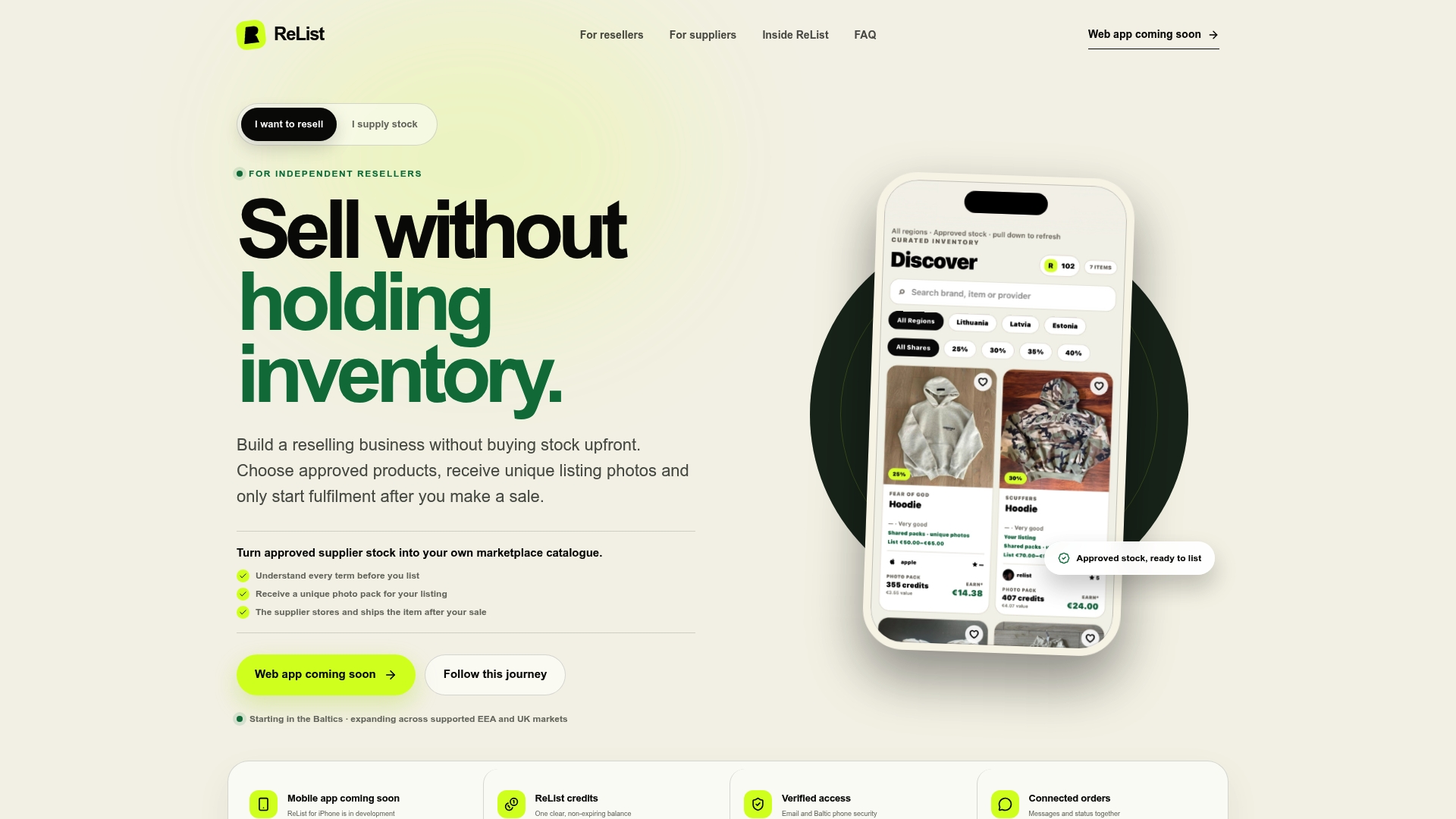
The platform connects you with approved suppliers who ship only after a sale closes, so you never carry stock. Each listing comes with product photos, which helps distinguish your catalog from others carrying similar inventory. A status tracker keeps you and your customer updated without a manual check-in, and the pricing model shows your costs before you commit to a listing, not buried in a fee schedule you find later. If you’re ready to see how the fulfillment side of this model can run without you managing every step by hand, visit Joinrelist and evaluate the platform against your own checklist.
Where to Learn More Before You List Your First Product
- KVK’s dropshipping guide covers your responsibilities as the customer’s point of contact.
- Shopify’s fulfillment documentation explains supplier types in depth.
- Check your own country’s consumer disclosure rules before you launch.
Sources
- What is Dropshipping? | Mailchimp
- Dropshipping checklist | ACM
- Dropshipping: selling products online | KVK
FAQ
What Does “Zero Upfront Cost” Mean in Reselling?
It means you list a supplier’s product without buying it first, and you pay the supplier only after a customer has already paid you. The supplier stores and ships the item, and you handle listing, pricing, and customer communication, as described in Mailchimp’s dropshipping definition.
Is Zero Upfront Cost Reselling the Same as Dropshipping?
Yes, it’s the retail mechanic behind dropshipping: no inventory purchase, and payment to the supplier happens after the sale rather than before. The terms describe the same operational model from two angles, one focused on cost structure and one on fulfillment.
How Do I Avoid Losing Money on Thin Margins?
Calculate your landed cost first, meaning supplier price plus fees, shipping, and a returns reserve, then set your price from that total rather than the supplier’s sticker price. Suppliers with unreliable shipping or high return rates erode margin fastest, so vetting matters as much as pricing.
Do I Need a Business License to Start?
Requirements vary by country and region, so check your local rules before you list your first product; KVK’s guide is a useful starting reference for one jurisdiction’s approach. You’re still legally the seller in the customer’s eyes even though a supplier ships the product.
Can ReList Help Me Manage Supplier Relationships?
The platform connects resellers with suppliers, provides listing photos, and includes a status tracker so you can monitor fulfillment without manually contacting suppliers. Current pricing and plan details are listed directly on Joinrelist.